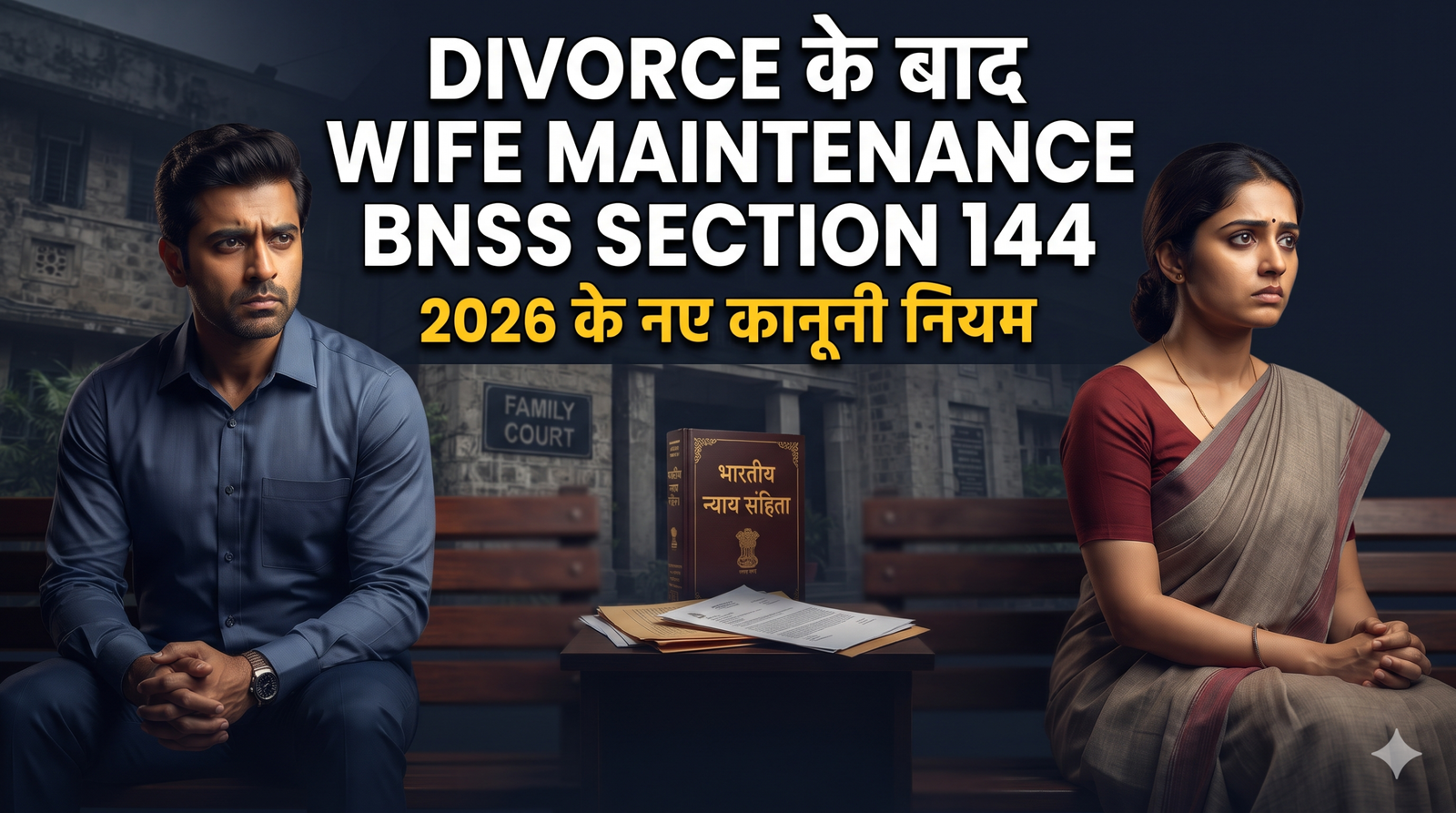

Introduction: Does a Husband Have to Pay Maintenance After Divorce?
Divorce does not always end the financial responsibilities between former spouses. Questions about maintenance, financial security, children’s expenses and legal rights can continue even after a marriage has legally ended.
One of the most common questions is whether a husband must pay maintenance to his divorced wife. Can a working wife claim maintenance? Is the amount calculated as a percentage of the husband’s salary? Have India’s new criminal laws, the Bharatiya Nyaya Sanhita (BNS) and the Bharatiya Nagarik Suraksha Sanhita (BNSS), changed the rules?
The answer depends on the applicable law and the facts of the case. Courts may consider both parties’ incomes, financial needs, liabilities, earning capacity and other relevant circumstances before deciding whether maintenance should be awarded and, if so, in what amount.
1. What Is the Law on Wife Maintenance After Divorce in India?
India has several legal provisions dealing with maintenance. The applicable provision depends on the circumstances of the case, the type of relief sought and the relevant personal law.
BNSS Section 144: Maintenance for Wives
Section 144 of the Bharatiya Nagarik Suraksha Sanhita, 2023, deals with maintenance for wives, children and parents. The BNSS came into force on 1 July 2024.
Under Section 144, a Magistrate may order a person with sufficient means to pay monthly maintenance if that person neglects or refuses to maintain a wife who is unable to maintain herself, subject to the legal requirements.
The law expressly includes a divorced woman who has not remarried within its definition of “wife” for this chapter.
The court may also grant interim maintenance and reasonable litigation expenses while the proceedings are pending. The statute says that an application for interim maintenance and proceeding expenses should, as far as possible, be decided within 60 days from the date notice is served.
This is not a guarantee that every maintenance case will be concluded within 60 days.
Official legal text: https://indiacode.ecourtsindia.com/bnss/section/144/
What Is the Difference Between BNS and BNSS?
The two laws serve different purposes.
- BNS — Bharatiya Nyaya Sanhita, 2023: Primarily deals with criminal offences and punishments.
- BNSS — Bharatiya Nagarik Suraksha Sanhita, 2023: Deals with criminal procedure and includes Section 144 on maintenance.
Therefore, BNSS Section 144 is the relevant general maintenance provision discussed in this context, rather than a general maintenance section under the BNS.
Section 144 broadly carries forward the role previously performed by Section 125 of the Code of Criminal Procedure, 1973 (CrPC). Earlier proceedings and legal events may still require consideration under the law applicable at the relevant time.
Official reference: https://www.mha.gov.in/en/commoncontent/new-criminal-laws
2. Can a Divorced Wife Claim Maintenance?
Yes. A divorced woman may be eligible to claim maintenance under applicable law, subject to the relevant legal conditions.
However, maintenance is not automatically payable in every divorce case. The court examines the facts and evidence before making an order.
Factors that may be relevant include:
- The wife’s income, assets and reasonable financial needs.
- The husband’s income, assets and earning capacity.
- The parties’ reasonable standard of living and financial circumstances.
- The cost of housing, healthcare and everyday living.
- Children’s education, healthcare and other expenses.
- The parties’ financial responsibilities and dependants.
- The duration of the marriage and the circumstances of separation.
- Any existing maintenance or alimony orders.
There is no single rule that determines the outcome of every case. A court must apply the relevant law to the evidence before it.
3. Can a Working Wife Claim Maintenance?
This is one of the most frequently asked questions in Indian family law.
Being employed does not automatically disqualify a wife from claiming maintenance. However, her actual income and financial independence may affect the court’s assessment.
Consider a hypothetical example: a wife earns ₹25,000 per month, while her husband earns ₹1,20,000 per month.
These figures alone do not establish how much maintenance, if any, should be awarded. The court may also consider the wife’s reasonable expenses, the husband’s liabilities, the parties’ overall financial positions and the legal provision under which the claim is made.
If a wife’s income is sufficient to meet her reasonable needs, that may affect the maintenance assessment. On the other hand, employment alone does not necessarily prove that she can support herself adequately.
For this reason, the terms “working wife maintenance in India” and “employed wife alimony rules” should not be interpreted as meaning that every employed wife is either automatically entitled to or automatically barred from maintenance.
4. How Much Maintenance Can a Wife Receive Based on Her Husband’s Salary?
There is no universal statutory formula under which every wife must receive 25%, 30% or 50% of her husband’s salary.
Courts assess the relevant circumstances, which may include:
- Actual income and available financial resources.
- Reasonable living expenses and housing costs.
- Medical expenses and other essential needs.
- Existing liabilities and financial obligations.
- The needs of dependent children.
- The parties’ standard of living and other relevant facts.
For example, if a husband earns ₹80,000 per month, that figure alone does not mean his wife is legally entitled to ₹20,000 per month. The example is hypothetical, not a legal calculation.
Financial disclosures, salary records, bank statements and other relevant documents may help the court assess the parties’ actual circumstances.
Neither party should conceal income or provide misleading financial information to influence the outcome.
5. What Is the Difference Between Interim Maintenance and Permanent Alimony?
Interim Maintenance
Interim maintenance is financial support that a court may order while legal proceedings are pending. Its purpose is to address eligible financial needs during the case.
Under BNSS Section 144, the court may also order reasonable expenses for the proceedings.
Permanent Alimony
Permanent alimony is financial support that may be ordered in connection with a divorce or afterwards, where the applicable law permits it.
Under the Hindu Marriage Act, 1955:
- Section 24 deals with maintenance pendente lite and expenses of proceedings.
- Section 25 deals with permanent alimony and maintenance.
These provisions have different purposes and legal requirements. A final divorce decree does not, by itself, mean that every existing or pending maintenance claim automatically disappears. The applicable statute, court orders and circumstances must be examined.
6. Why Is the Supreme Court Judgment in Rajnesh v. Neha Important?
The Supreme Court’s judgment in Rajnesh v. Neha, delivered on 4 November 2020, is an important authority in maintenance proceedings.
The judgment established guidelines concerning the disclosure of income, assets and liabilities, the treatment of maintenance claims in multiple proceedings, and factors relevant to determining maintenance.
In practical terms, courts may require both parties to provide financial information so that their circumstances can be assessed properly.
The judgment was delivered under the earlier CrPC framework. Its relevant principles remain important when considering maintenance proceedings under the successor provision, BNSS Section 144, subject to the applicable law and subsequent legal developments.
Judgment: https://indiankanoon.org/doc/117541087/
7. Can a Divorced Wife Be Denied Maintenance?
Yes. Eligibility depends on the legal provision being used and the circumstances of the case.
BNSS Section 144(4) contains specific restrictions. Under that provision, a wife is not entitled to receive maintenance from her husband if she is living in adultery, refuses to live with him without sufficient reason, or the parties are living separately by mutual consent.
The legal conditions and evidence must be assessed in the individual case. These restrictions should not be generalized to every form of maintenance or alimony available under other laws.
A wife’s income, remarriage and any previous maintenance or alimony arrangements may also be relevant, depending on the applicable provision.
In particular, BNSS Section 146 addresses alteration of maintenance allowances in specified circumstances, including certain consequences of remarriage and changes in circumstances.
8. What Documents May Be Needed for a Wife Maintenance Case?
Depending on the circumstances, a lawyer may recommend collecting the following documents:
- Marriage certificate or other evidence of marriage.
- Divorce petition, divorce decree and relevant court orders.
- Salary slips, bank statements and income-tax records, where relevant.
- Rent receipts, household expenses and medical bills.
- Children’s education expenses and healthcare records.
- Available evidence of both parties’ income, assets and liabilities.
- Copies of previous maintenance applications and court orders.
The exact documents required depend on the case and the court’s directions. Financial disclosures should be accurate and complete.
Conclusion: Maintenance Depends on the Law and the Facts
Wife maintenance after divorce in India cannot be determined solely by looking at the husband’s salary or whether the wife is employed.
BNSS Section 144, the Hindu Marriage Act and other applicable laws provide different legal routes for seeking maintenance or alimony. Courts consider the relevant legal conditions, financial disclosures and circumstances before deciding a claim.
It is also important to distinguish between BNS and BNSS: they are separate laws with different purposes.
Understanding the applicable provision, maintaining proper financial records and seeking advice from a qualified family-law advocate can help parties understand their legal rights and responsibilities.
Disclaimer: This article provides general legal information and is not a substitute for advice from a qualified lawyer. The outcome of an individual case depends on the applicable law, evidence and judicial assessment.
Frequently Asked Questions (FAQs)
Q1. Under which section can a wife claim maintenance after divorce in India?
Depending on the case, relevant provisions may include BNSS Section 144, Sections 24 and 25 of the Hindu Marriage Act, 1955, and the Protection of Women from Domestic Violence Act, 2005, among other applicable laws.
Q2. Can a working wife claim maintenance after divorce?
Yes, employment alone does not automatically bar a claim. Her actual income, reasonable needs and the parties’ financial circumstances may affect the court’s decision.
Q3. Is wife maintenance fixed at 25% of the husband’s salary?
No. There is no universal rule requiring every husband to pay 25% of his salary. The amount depends on the relevant law and the facts of the case.
Q4. When did BNSS Section 144 come into force?
The Bharatiya Nagarik Suraksha Sanhita, 2023, came into force on 1 July 2024. Section 144 deals with maintenance for wives, children and parents.
Q5. Can a divorced Muslim woman claim maintenance?
Potential remedies depend on the applicable statutory provisions and the circumstances. In Mohd. Abdul Samad v. State of Telangana, decided on 10 July 2024, the Supreme Court addressed a divorced Muslim woman’s right to seek maintenance under the former CrPC Section 125. The specific law applicable to an individual case should be checked.
Q6. Can a maintenance order be changed later?
Yes. BNSS Section 146 provides for alteration of maintenance allowances in specified circumstances, subject to the applicable legal requirements.
Additional legal references:
- BNSS Section 144: https://indiacode.ecourtsindia.com/bnss/section/144/
- Ministry of Home Affairs — New Criminal Laws: https://www.mha.gov.in/en/commoncontent/new-criminal-laws
- Supreme Court judgment, Mohd. Abdul Samad v. State of Telangana (10 July 2024): https://api.sci.gov.in/supremecourt/2024/3533/3533_2024_11_1501_53688_Judgement_10-Jul-2024.pdf
- Protection of Women from Domestic Violence Act, 2005: https://www.indiacode.nic.in/bitstream/123456789/2021/5/A2005-43.pdf