
Introduction: Can Artificial Intelligence Mislead a Court of Law?
Artificial intelligence is changing the way people conduct research, prepare documents and access legal information. Lawyers, businesses, researchers and even individuals increasingly use AI-powered tools to understand legislation, examine judgments and organize legal arguments. However, a serious question arises when technology produces legal authorities that do not actually exist.
Can a court rely on a judgment that was never delivered? What happens when a genuine case citation is accompanied by paragraphs that cannot be found in the original judgment? And who is responsible when unverified AI-generated material enters judicial decision-making?
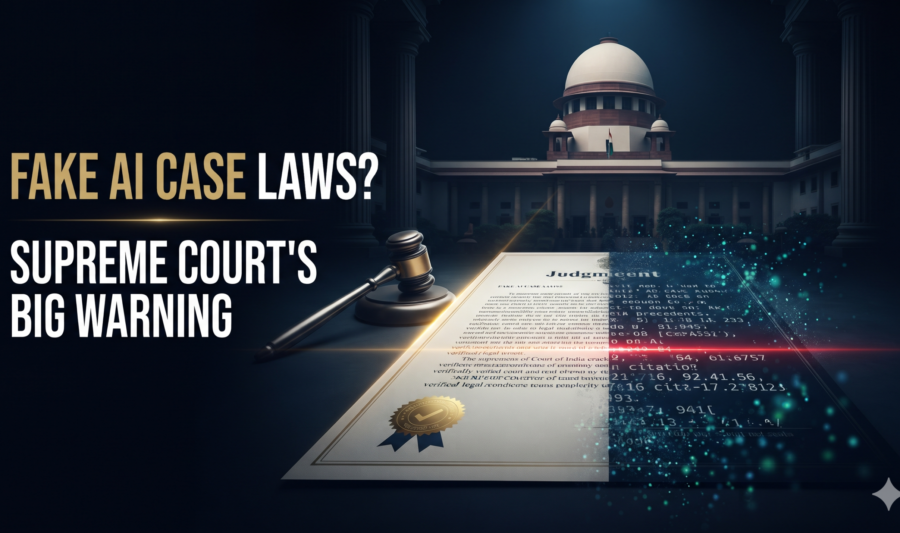
These questions came before the Supreme Court of India in Pooja Ramesh Singh v. Jammu and Kashmir Bank Ltd., 2026 INSC 668, decided on 2 July 2026.
The judgment addresses an important issue for the Indian legal system: the need to verify every legal authority before relying on it in judicial proceedings.
The Supreme Court set aside the orders passed by the National Company Law Tribunal (NCLT), Mumbai, and the National Company Law Appellate Tribunal (NCLAT) because the decision-making process had been affected by fabricated or hallucinated legal authorities. The underlying insolvency application was restored to its original number and sent back to the NCLT for fresh consideration on its merits.
The decision sends a clear message to legal professionals: technology may assist legal research, but accuracy, verification and professional responsibility cannot be delegated to an AI tool.
Official reference: Supreme Court of India, Pooja Ramesh Singh v. Jammu and Kashmir Bank Ltd., 2026 INSC 668, judgment dated 2 July 2026.
1. Background of the Case: How Did the Dispute Reach the Supreme Court?
The dispute originated from loan facilities obtained by Pan India Utilities Distribution Company Ltd. (PIUDCL) from Jammu and Kashmir Bank Ltd.
Essel Infraprojects Ltd. (EIL) had executed a corporate guarantee in connection with the borrowing. Following the borrower’s default, the bank classified the loan accounts as non-performing assets and initiated insolvency proceedings against EIL under Section 7 of the Insolvency and Bankruptcy Code, 2016.
On 28 August 2024, the NCLT, Mumbai, admitted the bank’s application, appointed an Interim Resolution Professional and declared a moratorium under Section 14 of the Insolvency and Bankruptcy Code.
The appellant, a suspended director of EIL, challenged the admission order before the NCLAT, disputing her liability as a guarantor. On 11 September 2025, the NCLAT dismissed the appeal.
During the subsequent proceedings before the Supreme Court, an important problem emerged. Six judgments relied upon in the NCLT’s reasoning, as reproduced by the NCLAT, were questioned because their citations or the paragraphs attributed to them could not be verified.
The problem was not limited to incorrect formatting or minor citation errors. Some authorities were found to be entirely non-existent, while other citations referred to genuine judgments but contained paragraphs that were not part of those decisions.
The Supreme Court independently examined the authorities and confirmed the problem.
This raised a fundamental concern: a judicial decision must rest on authentic legal sources, not material that merely appears convincing on a computer screen.
2. What Is an AI Hallucination in Legal Research?
An AI hallucination occurs when an artificial intelligence system generates information that appears plausible but is inaccurate, unsupported or fabricated.
In legal research, this may take several forms:
- Non-existent judgments: The system produces a case name or citation that does not correspond to any actual judicial decision.
- Incorrect case attribution: A genuine citation is associated with a different case, legal principle or judicial conclusion.
- Fabricated paragraphs: A real judgment is cited, but the quoted passage cannot be located in the original decision.
- Misstated legal principles: A judgment exists, but its actual reasoning or final ruling is inaccurately represented.
- Outdated legal information: The research overlooks amendments, later judgments or changes in the applicable law.
These errors can be particularly difficult to detect when the output is written in formal legal language and includes realistic case names, paragraph numbers and citations.
A professionally drafted-looking paragraph is not proof that its contents are genuine.
For this reason, lawyers should treat AI-generated legal research as material requiring independent verification rather than as an authoritative statement of law.
3. The Supreme Court’s Decision: Zero Tolerance for Fake Legal Precedents
The Supreme Court examined whether the NCLT and NCLAT orders could stand when the decision-making process relied on fabricated or hallucinated authorities.
The Court held that a decision founded on fake or hallucinated legal material cannot be sustained in law. It set aside the orders of both tribunals and restored the insolvency application to the NCLT for fresh disposal on its merits.
The Court also adopted a zero-tolerance approach towards the unverified use of AI-generated precedents by members of the Bar and the Bench.
The judgment is significant because it treats the issue as more than a technical research mistake. Judicial decisions derive their legitimacy from a reasoned application of law to established facts. Introducing fictional authorities into that process undermines the reliability of the adjudication itself.
The Court also directed the Bar Council of India to constitute a committee to consider the issue and formulate appropriate guiding principles and disciplinary consequences concerning the submission of fabricated or hallucinated legal precedents.
The ruling does not prohibit the legitimate use of AI in legal work. Instead, it emphasizes that AI-generated material must not be presented or relied upon as genuine legal authority without verification.
4. Why Did the Court Consider the Fake Citations So Serious?
A. Legal authorities must actually exist
A court relies on statutes, binding precedents and other legally relevant sources to determine the rights and liabilities of parties.
If a cited judgment does not exist, the court cannot independently examine its reasoning, factual context or legal ratio. The citation creates the appearance of authority without providing a genuine legal foundation.
B. A correct citation does not validate a fabricated quotation
One of the most important lessons from the case is that a citation can be genuine while the material attributed to it is false.
Accordingly, checking only the case name and citation number is insufficient. The actual judgment must be opened and the relevant passage examined.
C. Fabricated authorities can escape multiple levels of scrutiny
The case also demonstrated that inaccurate material may pass through more than one stage of judicial proceedings before it is challenged.
This reinforces the need for verification at every stage, including the preparation of pleadings, the filing of written submissions, oral arguments and the examination of authorities by adjudicating bodies.
D. Judicial independence requires reliable legal reasoning
Courts must reach decisions through an independent evaluation of facts and law. An AI-generated answer cannot replace that responsibility.
The Court emphasized the importance of maintaining control over how AI is used in adjudication. The objective is not to reject technological progress but to prevent unreliable outputs from contaminating the judicial process.
5. Important Legal Principles Emerging from the Judgment
Principle 1: Every legal citation must be independently verified
An advocate should confirm that the cited judgment exists, that the citation is accurate and that the proposition attributed to the judgment is supported by the original text.
A citation copied from an AI chatbot, online summary or secondary article should not be treated as verified merely because it appears plausible.
Principle 2: AI is an aid, not an independent source of legal authority
AI can assist with preliminary research, organizing facts, generating research questions and summarizing lengthy documents. However, its output must be checked against authentic legal sources.
The final responsibility for the accuracy of legal submissions remains with the professional who prepares or presents them.
Principle 3: Accuracy matters even when the document appears professionally drafted
Legal writing depends on the substance of the authority cited, not simply the style of the document.
A fabricated quotation does not become reliable because it is written in formal language or placed within a correctly formatted legal submission.
Principle 4: Courts must protect the integrity of adjudication
The Supreme Court’s approach underscores that judicial reasoning must remain anchored in genuine legal material.
The Court’s ruling also highlights the importance of professional accountability when unreliable material is introduced into judicial proceedings.
Principle 5: Legitimate AI use remains possible
The judgment should not be misunderstood as a blanket prohibition on AI-assisted legal work. The distinction is between using technology responsibly and presenting fabricated or unverified material as an authentic judicial precedent.
Legal professionals can benefit from AI tools, provided they maintain appropriate human oversight and verify the underlying authorities.
6. Practical Checklist: How Lawyers Can Verify AI-Generated Case Laws
Lawyers and legal researchers can reduce the risk of citation errors by following a structured verification process.
Step 1: Search for the original judgment.
Locate the decision on an official court website or another reliable legal database. Begin with the court, case title, citation number and date.
Step 2: Confirm the complete case details.
Check the parties’ names, court, bench, date of decision and reported or neutral citation. Be alert to similarly named cases and citation numbers that may belong to different judgments.
Step 3: Read the relevant paragraph in context.
Do not rely solely on a search result, AI summary or isolated quotation. Read the paragraph and enough surrounding text to understand the issue being decided.
Step 4: Verify the actual legal proposition.
A judgment may discuss a principle without making it the basis of its final decision. Confirm whether the cited proposition forms part of the court’s reasoning and whether the decision is relevant to the facts of the current matter.
Step 5: Check subsequent legal developments.
Determine whether the judgment has been distinguished, overruled, modified or affected by a later statutory amendment or binding decision.
Step 6: Preserve the source used for the submission.
Maintain an organized research record containing the judgment, relevant paragraphs, citation details and the legal proposition for which the authority is relied upon.
Step 7: Conduct a final review before filing.
Every citation, quotation, statutory provision and case summary should be checked before a pleading, written submission or legal opinion is finalized.
These steps are particularly important in complex matters involving insolvency, commercial disputes, taxation, property rights and constitutional questions.
7. What Does This Judgment Mean for Corporate Legal Services?
The judgment has practical implications beyond courtroom advocacy. Businesses routinely depend on legal research when entering into contracts, responding to statutory notices, managing regulatory obligations and handling disputes.
An inaccurate legal reference in a corporate opinion or compliance document can create confusion, lead to poor decisions and increase the risk of litigation.
Companies using AI tools for internal legal research should therefore establish a review process that distinguishes preliminary information from verified legal advice.
Before relying on a legal opinion, businesses should consider whether:
- The relevant legislation has been checked in its current form.
- The cited judgments are authentic and relevant.
- Contractual and regulatory obligations have been examined in context.
- Important factual assumptions have been verified.
- The advice has been reviewed by an appropriately qualified legal professional.
For organizations seeking assistance with contracts, commercial disputes, banking matters or regulatory questions, structured legal review can help identify issues before they develop into larger disputes.
Read more about Corporate Legal Services in Lucknow to understand how legal documentation, procedural compliance and professional guidance can support better business decisions.
8. Relevance for Civil, Property and Financial Disputes
The importance of authentic legal research extends to almost every area of litigation.
In property disputes, a lawyer may need to examine title documents, revenue records, statutory provisions and precedents concerning ownership or possession.
In financial and insolvency disputes, the applicable law may involve contractual obligations, guarantees, limitation periods and proceedings before specialized tribunals.
In civil and family matters, accurate legal advice may depend on statutory provisions, relevant judicial decisions and the specific facts of the dispute.
A legal authority that is incorrectly quoted or taken out of context can weaken a submission and create avoidable complications.
For property buyers and owners, legal due diligence remains an important safeguard before completing a transaction. Read our guide to Property Title Verification in Lucknow for a practical overview of ownership documents, revenue records, encumbrances and other relevant checks.
The broader lesson is straightforward: reliable legal work requires authentic sources, careful analysis and proper documentation.
9. How VS Advocates Legal Solutions India Pvt. Ltd. Approaches Legal Assistance
VS Advocates Legal Solutions India Pvt. Ltd. is a Lucknow-based legal consultancy offering assistance across civil, criminal, property, family, revenue, taxation, banking, commercial and related legal matters.
The organization describes its approach as centered on procedural accuracy, professional ethics, legal research, proper documentation and clear communication.
These principles are relevant when reviewing legal documents, understanding procedural requirements and evaluating the available options in a dispute.
Every legal matter has its own facts, evidence and applicable rules. A legal consultation should therefore begin with an examination of the relevant documents and circumstances rather than assumptions about the likely outcome.
Individuals and organizations seeking legal guidance can learn more about the organization’s services on the official VS Advocates website.
For case-specific enquiries, contact the office to discuss the nature of the matter and the documents available for review.
Contact details
VS Advocates Legal Solutions India Pvt. Ltd.
Address: Z3V-14/P-11 (KH-162), Tiwaripur, Jankipuram Vistar, Lucknow, Uttar Pradesh – 226031
Phone: +91 7388000055 / +91 9511150638
Email: office@vsadvocateslegal.com
Website: https://vsadvocateslegal.com/
10. Frequently Asked Questions
Q1. What is the Supreme Court’s judgment in Pooja Ramesh Singh v. Jammu and Kashmir Bank Ltd.?
It is a Supreme Court judgment dated 2 July 2026, reported as 2026 INSC 668, concerning the use of AI-generated fake or hallucinated case law in judicial proceedings.
Q2. Why were the NCLT and NCLAT orders set aside?
The Supreme Court found that the decision-making process relied on non-existent legal citations and paragraphs wrongly attributed to genuine judgments. The Court set aside the orders and remitted the underlying insolvency application to the NCLT for fresh consideration on its merits.
Q3. Has the Supreme Court prohibited the use of AI by lawyers?
No. The ruling does not impose a blanket ban on legitimate AI use. It emphasizes that fabricated or hallucinated legal authorities must not be presented or relied upon as genuine precedents without verification.
Q4. Can an AI tool be used to research Supreme Court judgments?
AI may assist with preliminary research and document analysis. However, users should independently verify every citation, quotation and legal proposition against the original judgment and applicable law.
Q5. What should a lawyer do before citing an AI-generated case reference?
The lawyer should locate the original judgment, verify its citation and relevant paragraphs, confirm the legal proposition and check whether subsequent decisions have affected its status.
Q6. Where can the official judgment summary be accessed?
The Supreme Court of India’s official website publishes landmark judgment summaries. Readers should consult the official source and the original judgment before relying on the decision in legal proceedings.
Official source: https://www.sci.gov.in/landmark-judgment-summaries/
Conclusion: Technology Can Assist Legal Research, but Verification Is Essential
The Supreme Court’s decision in Pooja Ramesh Singh v. Jammu and Kashmir Bank Ltd. is an important reminder that the reliability of legal proceedings depends on the authenticity of the material placed before the court.
AI tools can make research faster and help organize complex information. However, they can also produce convincing but inaccurate citations, invented quotations and misleading legal summaries.
The responsibility to verify the law cannot be replaced by automated output. Advocates, legal researchers and adjudicating bodies must ensure that the authorities relied upon are genuine, relevant and accurately represented.
For businesses and individuals alike, the judgment reinforces the value of careful legal research, transparent communication and professionally reviewed documentation.
At VS Advocates Legal Solutions India Pvt. Ltd., the emphasis remains on responsible legal assistance, procedural clarity and informed decision-making.
For further information about legal consultancy in Lucknow, visit https://vsadvocateslegal.com/ or contact +91 7388000055.
Legal Disclaimer
This article is intended for general legal awareness and informational purposes only. It is not a substitute for case-specific legal advice and should not be relied upon as a pleading, legal opinion or representation of the complete judgment. Readers should consult the original judicial decision and applicable law before taking legal action. No particular legal outcome is guaranteed.