Taking a loan is often a practical decision. People borrow money to manage medical expenses, support their families, purchase a house, expand a business, or handle an unexpected financial crisis.
But life does not always go according to plan.
A business may suffer losses. A person may lose their job. Medical expenses may suddenly increase. Sometimes, even after making regular EMI payments for years, a financial emergency can make repayment difficult.
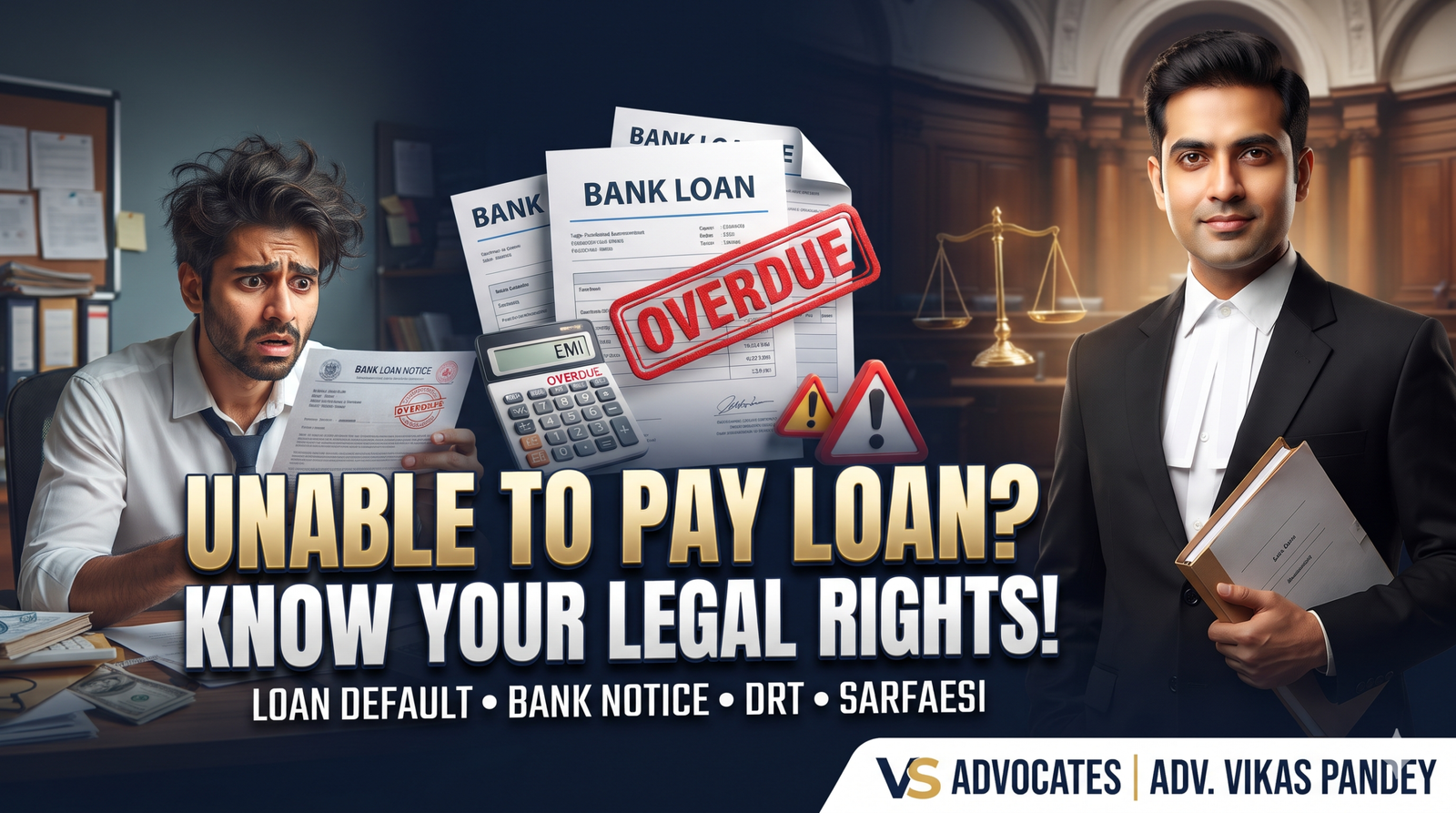
If you are currently unable to pay your loan EMI, you may be worried about bank calls, recovery agents, legal notices, or possible court proceedings.
The first thing you should understand is this: A genuine inability to repay a loan does not automatically make you a criminal.
However, ignoring your loan obligations or legal notices can create additional complications. Understanding your rights and responsibilities can help you make better decisions.
At VS Advocates Legal Solutions India Pvt. Ltd., Lucknow, we provide legal consultancy and assistance relating to banking disputes, loan recovery matters, financial disputes, DRT proceedings, and other civil and commercial legal matters.
1. What Happens If You Cannot Pay Your Loan EMI?
When a borrower misses an EMI, the lender may initiate its recovery process according to the loan agreement and applicable law.
Depending on the type of loan, security, and default, possible consequences may include:
- Late payment charges and applicable penal charges.
- Additional interest as permitted by the loan agreement.
- Follow-up calls and repayment reminders.
- Reporting of payment defaults to credit information companies.
- Issuance of a demand or legal notice.
- Civil recovery proceedings.
- Secured asset enforcement proceedings where applicable.
- SARFAESI proceedings in eligible secured loan cases.
The consequences depend on the nature of the loan, the lender, the outstanding amount, and the legal documents involved.
A personal loan, credit card debt, home loan, vehicle loan, and business loan may involve different recovery procedures.
2. Can a Bank Send Recovery Agents to Your Home?
Yes, banks and financial institutions may engage authorized recovery agents to contact borrowers and pursue lawful recovery.
However, recovery must be conducted within applicable legal and regulatory boundaries.
A borrower should not be subjected to:
- Threatening or abusive language.
- Physical intimidation.
- Public humiliation.
- Harassment of family members.
- Unlawful pressure at the workplace.
- Repeated intrusive contact in violation of applicable guidelines.
- Threats of arrest without a lawful basis.
The RBI has issued guidelines concerning the conduct of recovery agents and fair practices for regulated entities.
If you experience harassment, preserve call records, messages, letters, and other relevant evidence. You may raise a complaint with the lender’s grievance redressal mechanism and, where eligible, the RBI Integrated Ombudsman Scheme.
3. Can You Go to Jail for Not Paying a Personal Loan?
This is one of the most frequently asked questions by borrowers.
Ordinary inability to repay a loan is generally a civil financial default. A person does not automatically face criminal prosecution merely because an EMI was missed.
However, the legal position may change where there are separate allegations involving:
- Cheating or dishonest inducement.
- Fraudulent documents.
- Deliberate misrepresentation.
- Criminal breach of trust, where its legal ingredients are established.
- Cheque dishonour proceedings under Section 138 of the Negotiable Instruments Act, where applicable.
The facts and evidence matter.
A borrower should not assume that every bank complaint is criminal, but should also never ignore a genuine court summons or legal notice.
4. What If You Receive a Legal Notice From a Bank or Finance Company?
Receiving a legal notice can be stressful, especially when you are already facing financial difficulties.
But ignoring it is rarely a good decision.
Consider the following steps:
- Read the complete notice carefully.
- Verify the lender’s name, loan account details, amount claimed, and legal basis.
- Check the repayment history and outstanding statement.
- Review the loan agreement and any security documents.
- Preserve all payment receipts and communication.
- Seek legal advice before sending a formal reply.
- Explore lawful repayment or settlement options.
A timely response may help clarify disputed amounts, incorrect calculations, or other issues.
5. What Is SARFAESI Act? Can a Bank Take Your Property?
The Securitisation and Reconstruction of Financial Assets and Enforcement of Security Interest Act, 2002, commonly known as the SARFAESI Act, provides a legal framework for enforcement of certain secured financial assets.
In eligible cases, secured creditors may initiate enforcement proceedings after satisfying statutory requirements.
Section 13(2) generally deals with a demand notice requiring the borrower to discharge the liability within 60 days.
If a borrower has objections to the demand notice, Section 13(3A) provides a mechanism for the secured creditor to consider and communicate its reasons.
Further remedies may be available before the Debt Recovery Tribunal under Section 17, subject to the applicable legal requirements.
If you receive a SARFAESI notice, do not ignore it. The applicable timelines can be important.
6. Can You Negotiate a Loan Settlement With a Bank?
In certain situations, a borrower may approach the lender to discuss repayment restructuring or a negotiated settlement.
Depending on the lender’s policy and circumstances, possible options may include:
- Restructuring of repayment.
- Revision of repayment schedules.
- Extension of the loan tenure.
- Negotiated one-time settlement.
- Payment through mutually agreed instalments.
- Closure after payment of the agreed settlement amount.
However, a one-time settlement is not an automatic legal right. Approval depends on the lender’s applicable policy and the individual circumstances.
Before accepting a settlement, obtain written confirmation of the terms, payment schedule, and consequences for your credit record.
7. What Should You Do If You Are Unable to Pay Your Loan?
Instead of avoiding the bank, take practical steps:
- Calculate your actual monthly income and expenses.
- Identify the amount you can realistically repay.
- Communicate with the lender through official channels.
- Request a written statement of outstanding dues.
- Avoid borrowing from another expensive source just to pay an existing EMI without considering the consequences.
- Do not sign blank papers or make undocumented promises.
- Seek legal advice if you receive a court notice, DRT notice, or SARFAESI notice.
Being financially stressed does not mean you should give up on understanding your legal rights.
8. Legal Assistance for Loan Recovery and Banking Disputes in Lucknow
If you are facing loan recovery pressure, a banking dispute, a SARFAESI notice, or proceedings before the Debt Recovery Tribunal, professional legal guidance can help you understand the available remedies.
VS Advocates Legal Solutions India Pvt. Ltd., under the professional guidance of Adv. Vikas Pandey, High Court Lucknow practitioner, provides legal consultancy and assistance in matters involving:
- Bank loan recovery disputes.
- Personal loan and business loan disputes.
- SARFAESI Act proceedings.
- DRT and debt recovery matters.
- Financial and commercial disputes.
- Legal notices and recovery proceedings.
- Banking-related civil litigation.
Contact VS Advocates – Lucknow
Adv. Vikas Pandey | High Court Lucknow
Office: Room No. 1, Z3V-14, P-11 (KH-162), Near RS Plaza, Chhata Meel, Jankipuram Extension, Lucknow, Uttar Pradesh – 226201.
Phone / WhatsApp: +91 95111 50365
Website: https://vsadvocateslegal.com
Frequently Asked Questions
Q1. What happens if I cannot pay my personal loan EMI?
The lender may charge applicable overdue amounts, report the default to credit information companies, issue notices, and initiate lawful recovery proceedings.
Q2. Can a bank threaten me with arrest for not paying a loan?
Ordinary loan default does not automatically justify arrest. Separate criminal allegations must be assessed on their own legal merits.
Q3. Can recovery agents visit my house?
Authorized recovery agents may contact borrowers and visit them in accordance with applicable rules and guidelines. Harassment, intimidation, and abusive conduct are not acceptable.
Q4. Can I settle my loan for less than the outstanding amount?
A negotiated settlement may be possible if the lender approves it. Always obtain written terms before making payment.
Q5. Which lawyer handles bank loan recovery cases in Lucknow?
A lawyer experienced in banking disputes, civil litigation, SARFAESI matters, and DRT proceedings can advise you according to the facts of your case.
Final Thoughts
Financial difficulties can happen to anyone. A missed EMI should not make you feel that you have lost all your legal rights.
Understand the notice, verify the lender’s claim, maintain your documents, and seek proper legal guidance before taking any major decision.
VS Advocates Legal Solutions India Pvt. Ltd. – Legal Consultancy for Banking, Financial and Recovery Matters in Lucknow.
Disclaimer: This article is for general legal awareness and does not constitute legal advice. Legal remedies depend on the loan documents, facts, and applicable laws. No particular outcome is guaranteed.