
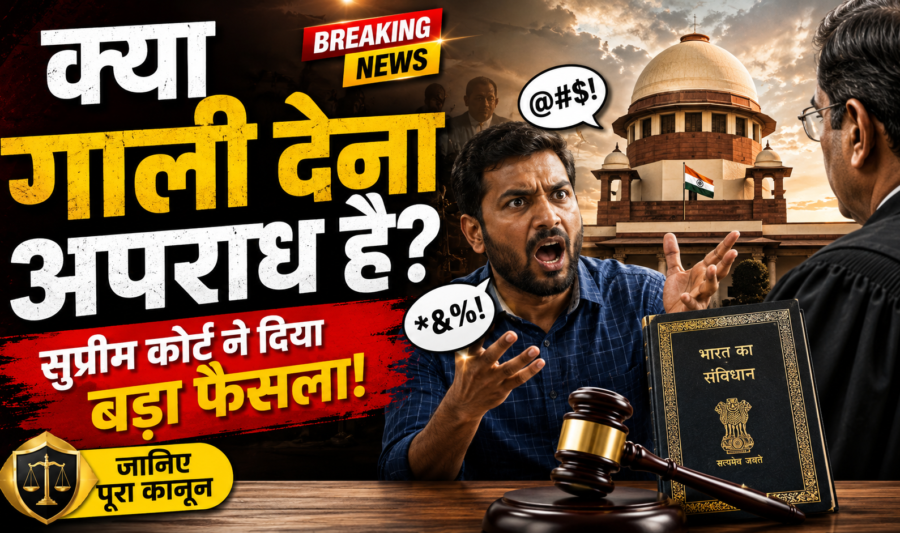
The Supreme Court of India has clarified an important legal question that often creates confusion: Does using abusive or offensive language automatically amount to the offence of obscenity? According to the Court, the answer is No.
In a recent judgment, the Supreme Court explained that abusive words, insults, or vulgar language do not by themselves constitute the offence of obscenity under criminal law. The Court emphasized that there is a clear legal distinction between obscene expression and offensive or insulting language.
What Did the Supreme Court Say?
A Bench comprising Justice Sanjay Karol and Justice Vipul M. Pancholi observed that merely using rude, abusive, or vulgar words—even if they are offensive or socially unacceptable—does not automatically make a person guilty of the offence of obscenity.
The Court stated that obscenity has a specific legal meaning. For words or expressions to be considered obscene, they must generally:
- Be sexually explicit or lascivious in nature.
- Be capable of arousing sexual thoughts or desires.
- Have a tendency to deprave or corrupt the minds of persons likely to read or hear them.
Simply using harsh language, insults, or profanities may be offensive, but it does not satisfy these legal requirements.
Obscenity Is Different from Vulgarity
The judgment highlights an important distinction. Language that is rude, vulgar, or abusive may provoke anger, disgust, or shock, but that alone does not make it legally obscene.
The Supreme Court noted that earlier judicial decisions have consistently recognized that vulgarity and obscenity are not synonymous. While certain words may be socially unacceptable, they do not become obscene unless they meet the legal test laid down by law.
Background of the Case
The ruling arose from a land dispute in Tamil Nadu involving a 70-year-old man who had been convicted under multiple provisions of the Indian Penal Code (IPC).
The Supreme Court set aside his conviction under:
- Section 294(b) IPC – Obscene acts and uttering obscene words in public.
- Section 506(2) IPC – Criminal intimidation.
However, the Court upheld his conviction under Section 326 IPC, which deals with voluntarily causing grievous hurt by dangerous weapons or means.
Considering the appellant’s advanced age, medical condition, and the fact that the incident arose out of a property dispute, the Court modified the sentence to imprisonment till the rising of the Court along with a fine of ₹50,000.
Why This Judgment Matters
The decision reinforces that criminal liability for obscenity cannot be based merely on offensive speech. Courts must carefully examine whether the words used actually possess the characteristics required to qualify as obscene under law.
This distinction is important because criminal statutes should not be applied broadly to punish every instance of rude or offensive language. The legal threshold for obscenity is significantly higher and requires proof that the expression is sexually explicit and capable of corrupting or depraving those exposed to it.
Key Takeaways
- Abusive or offensive language does not automatically amount to obscenity.
- Obscenity is legally distinct from vulgarity, insults, or profanity.
- To constitute the offence of obscenity, the words must generally be sexually explicit, lascivious, and capable of corrupting or depraving the minds of others.
- The Supreme Court quashed the convictions under Sections 294(b) and 506(2) IPC but upheld the conviction under Section 326 IPC in the case.
Disclaimer: This article is intended solely for educational and informational purposes. It provides a general summary of a judicial decision and should not be treated as legal advice. Readers should consult a qualified legal professional for advice regarding specific legal issues.