Delhi Protests and Supreme Court: 18 Petitions Raise Questions Over Police Conduct and Civil Liberties
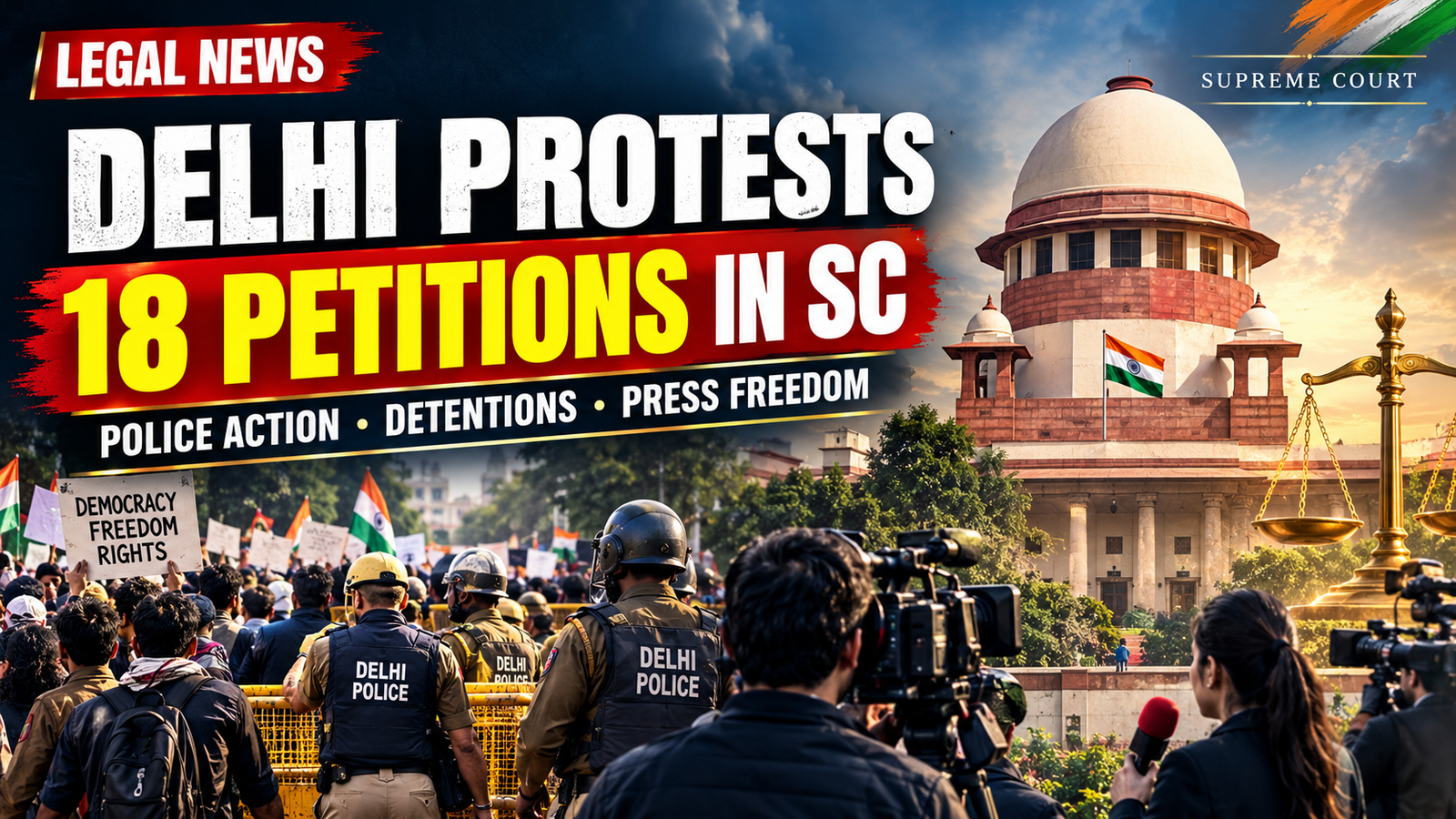
New Delhi: The Supreme Court of India is examining a series of petitions arising from protests held in Delhi on October 10 and 11, 2026, concerning demands for the resignation of Chief Election Commissioner Gyanesh Kumar over the Special Intensive Revision (SIR) of electoral rolls and the functioning of the Election Commission of India (ECI).
According to the details of the proceedings, 18 petitions and applications have raised concerns about alleged police excesses, detention of protesters, treatment of lawyers and journalists, restrictions on public transport, mobile internet suspension and compliance with earlier judicial directions.
The matters include writ petitions, contempt proceedings, habeas corpus pleas and applications seeking intervention in ongoing cases. Several petitioners have requested independent inquiries, preservation of evidence, disclosure of prohibitory orders and safeguards against arbitrary detention.
The proceedings are listed before a Supreme Court Bench comprising Chief Justice of India Surya Kant and Justices Joymalya Bagchi and V. Mohana.
The allegations raised in these petitions are matters for judicial consideration and should not be treated as established findings unless confirmed by the Court.
Why Are the Delhi Protests Before the Supreme Court?
The protests were organised by youth groups and political parties amid concerns over the SIR exercise and alleged irregularities in electoral rolls. The demonstrations reportedly led to the detention of protesters and allegations of assault involving lawyers, journalists and other participants.
The Supreme Court’s earlier directions on October 9 addressed restrictions on public transport and movement. During a special sitting on October 11, the Court also addressed concerns about compliance with its directions and the ability of lawyers and journalists to perform their professional duties without unlawful obstruction.
The subsequent petitions raise broader questions concerning the balance between public order and constitutional freedoms, including personal liberty, freedom of expression and access to justice.
Supreme Court Petitions Linked to Delhi Protests: Key Cases Explained
1. MA Baby v. Union of India
This petition challenges restrictions affecting Delhi Metro and railway services during the protests. The matter concerns the extent to which public transport can be regulated during demonstrations without completely disrupting essential public movement.
The Supreme Court’s October 9 directions reportedly allowed regulation of public transport while opposing a complete prohibition on services.
2. Shailendra Mani Tripathi v. Govind Mohan
Advocate Shailendra Mani Tripathi filed a contempt petition alleging that the closure of metro stations and restrictions on railway services violated the Court’s October 9 directions.
The Supreme Court issued notices to Union Home Secretary Govind Mohan, Delhi Police Commissioner Anurag Kumar and Delhi Metro Rail Corporation Chairperson D. Thara after finding a prima facie case requiring a response.
3. Menaka Guruswamy v. Union of India
Senior Advocate and Trinamool Congress MP Menaka Guruswamy approached the Supreme Court through a habeas corpus petition concerning the detention of political leaders, including Arvind Kejriwal, Mamata Banerjee, Pinarayi Vijayan and Manik Sarkar.
Although the detainees were subsequently released, the petition raises questions about the legality of detention during protests and the circumstances in which judicial intervention may be warranted.
4. Aman Prasad v. Anurag Kumar
Advocate Aman Prasad has sought contempt proceedings against Delhi Police Commissioner Anurag Kumar over alleged excessive use of force against protesters, including women and lawyers.
The petition alleges non-compliance with the Supreme Court’s directions relating to police conduct and public movement.
5. Journalist Amaan Rastogi’s Contempt Petition
Journalist Amaan Rastogi, associated with Molitics, has approached the Supreme Court alleging that he was assaulted by police while reporting on the demonstrations.
The petition seeks action against the Union Home Secretary and Delhi Police Commissioner over alleged violations of judicial directions intended to protect journalists performing their professional duties.
6. Supreme Court Bar Association v. Union of India
The Supreme Court Bar Association has sought a status report concerning the alleged detention and manhandling of advocates near the Supreme Court on October 10.
Its requests reportedly include disclosure of prohibitory orders issued under Section 163 of the Bharatiya Nagarik Suraksha Sanhita (BNSS), preservation of CCTV footage and measures to ensure lawyers can access the courts without unlawful obstruction.
7. Supreme Court Advocates-on-Record Association v. Union of India
The Supreme Court Advocates-on-Record Association (SCAORA) has sought an independent, impartial and time-bound inquiry into allegations that lawyers were detained and manhandled during the protest march.
The application also seeks identification of the police personnel involved, preservation of relevant evidence and protection against intimidation or retaliation.
8. Petition Challenging Prohibitory Orders Under the BNSS
A separate petition, mentioned before the Court by Senior Advocate Gopal Sankaranarayanan, questions restrictions imposed under Section 163 of the BNSS.
It also raises concerns regarding Section 172, which deals with the duty to comply with lawful police directions and related police powers. The Court was informed of allegations of police excesses involving lawyers and protesters.
9. Free Speech Collective v. Union of India — Contempt Petition
The journalists’ organisation Free Speech Collective has sought contempt action over the alleged detention and forcible removal of journalists covering the protests.
The petition concerns the implementation of the Supreme Court’s October 11 directions regarding the ability of journalists, lawyers and other professionals to perform their duties without unlawful interference.
10. Free Speech Collective — Separate Writ Petition
In a separate proceeding, Free Speech Collective has sought an independent inquiry into alleged police violence against journalists.
The reliefs sought reportedly include preservation of evidence, compensation for affected individuals and binding guidelines governing police interaction with media personnel reporting on protests.
11. Network of Women in Media, India
The Network of Women in Media, India, has approached the Supreme Court seeking safeguards against the alleged arbitrary detention, intimidation and forcible removal of journalists.
The petition particularly highlights concerns involving women journalists covering demonstrations and police operations.
12. AA Rahim v. Union of India
CPI(M) Rajya Sabha MP AA Rahim has sought an independent inquiry into the alleged illegal detention and custodial assault of Democratic Youth Federation of India (DYFI) members during the October 11 protests.
The petition also seeks preservation of police records, medical examinations of injured protesters and safeguards governing detention in protest-related cases.
13. Lawyers’ Association for Constitution (LAFC)
The Lawyers’ Association for Constitution has filed a petition under Article 32 of the Constitution alleging that four of its member advocates were unlawfully detained and manhandled by Delhi Police on October 10 and 11.
Filed through advocate Pyoli, the petition raises concerns about alleged police excesses involving lawyers, women, juveniles, journalists and other civilians.
14. Narendra Kumar Goswami’s Petition on Mobile Internet Suspension
Advocate Narendra Kumar Goswami has challenged the suspension of mobile internet services within a four-kilometre radius of the Janpath–Kartavya Path crossing on October 9 and 10.
The petition seeks judicial scrutiny of the orders imposing the restrictions and the legal basis for suspending connectivity in the affected area.
15. Apoorvanand Jha’s Petition on Alleged Assault of Students
Professor Apoorvanand Jha has approached the Supreme Court alleging that students were assaulted and tortured during the protests.
Senior Advocate Nitya Ramakrishnan informed the Court that details of the alleged abuse, together with medical reports relating to affected students, had been furnished to the government.
She sought a response to the allegations. The Court indicated that the government could submit additional affidavits addressing specific allegations after filing its responses in the principal matters.
16. Petition Over INDIA Bloc Leaders Entering Supreme Court Premises
A separate petition filed by four lawyers concerns the entry of Rahul Gandhi and other INDIA bloc leaders into the Supreme Court premises on October 12.
The plea, mentioned by Senior Advocate Gaurav Bhatia, seeks restrictions on political demonstrations within court premises and contempt action against the Kerala unit of the Congress party over remarks directed at Chief Justice of India Surya Kant.
17. Swaty Singh Malik’s Plea Alleging Assault and Forcible Detention
Advocate Swaty Singh Malik has sought intervention in the pending contempt proceedings concerning the detention of lawyers during the October 10 protests.
She alleges that four female police personnel forcibly detained and manhandled her, causing bruising. She has also claimed that she was placed in a poorly ventilated police bus and that police personnel tore a poster bearing the Preamble to the Constitution.
Her application refers to alleged violations of Articles 14, 19, 21 and 22 of the Constitution, which concern equality before the law, specified freedoms, life and personal liberty, and safeguards against arrest and detention.
18. Kerala Union of Working Journalists’ Plea
The Delhi unit of the Kerala Union of Working Journalists (KUWJ) has approached the Supreme Court over allegations of assault and detention involving journalists who covered the demonstrations on October 10 and 11.
The petition adds to the wider set of proceedings seeking accountability and protection for media professionals reporting on public protests.
Separate SIR Challenge by Rahul Gandhi and Opposition Leaders
Apart from the petitions concerning police conduct and detention, Rahul Gandhi and other opposition leaders have challenged the Special Intensive Revision of electoral rolls.
Their petition raises concerns about alleged large-scale voter deletions and irregularities in the SIR exercise. The reliefs sought reportedly include the production of Election Commission records, an independent audit of voter deletions and interim suspension of the exercise.
This challenge is distinct from the proceedings concerning the alleged treatment of protesters, lawyers and journalists. According to the available case details, it was not listed for hearing on the date covered by the report.
What Constitutional Issues Are at Stake?
The petitions collectively raise several important legal questions.
Personal liberty and unlawful detention: The habeas corpus proceedings and individual applications question whether detentions during the protests complied with applicable law and constitutional safeguards.
Freedom of speech and peaceful assembly: The challenges to restrictions on public movement and demonstrations raise questions about the permissible limits of state action during public protests.
Press freedom and journalists’ safety: Multiple petitions seek protection for journalists covering demonstrations and question allegations of assault or forcible removal.
Access to justice: The applications filed by bar associations raise concerns about lawyers’ ability to reach courts and discharge their professional responsibilities.
Compliance with judicial directions: The contempt proceedings ask the Court to examine whether authorities complied with its earlier directions concerning transport, public movement and professional activities.
Transparency and accountability: Requests for CCTV footage, police records, medical documentation and independent inquiries seek to establish the facts surrounding the alleged incidents.
The precise legal consequences will depend on the evidence, the responses filed by the authorities and the Supreme Court’s findings in the individual proceedings.
What Happens Next?
The Supreme Court is considering connected matters involving alleged police excesses, detention, restrictions on public services and compliance with earlier judicial directions. Some of the petitions are listed for hearing on Tuesday, according to the case information available for this report.
The authorities’ responses and the Court’s subsequent orders will be important in determining which allegations require further investigation and whether additional safeguards or other reliefs are warranted.
The separate challenge to the SIR exercise raises electoral-roll issues that must be considered independently from the petitions concerning the handling of protests.
Conclusion
The 18 petitions arising from the Delhi protests place several questions of public importance before the Supreme Court, including police accountability, personal liberty, freedom of the press, access to justice and the regulation of public demonstrations.
While the petitioners have made serious allegations, the claims remain subject to judicial examination. The proceedings will determine how the relevant legal provisions and constitutional protections apply to the events of October 10 and 11.
For the latest developments, readers should refer to official Supreme Court orders and subsequent verified court reporting.
SEO Publishing Checklist
Primary keyword: Delhi protests Supreme Court petitions
Secondary keywords:
- Delhi protest police action 2026
- Supreme Court petitions against Delhi Police
- Delhi protest detentions and assaults
- Supreme Court contempt petitions
- Journalists assaulted during Delhi protests
- Lawyers detained in Delhi protests
- Supreme Court press freedom case
- Section 163 BNSS Delhi protests
- Special Intensive Revision voter deletion case
- Delhi protests October 10 and 11
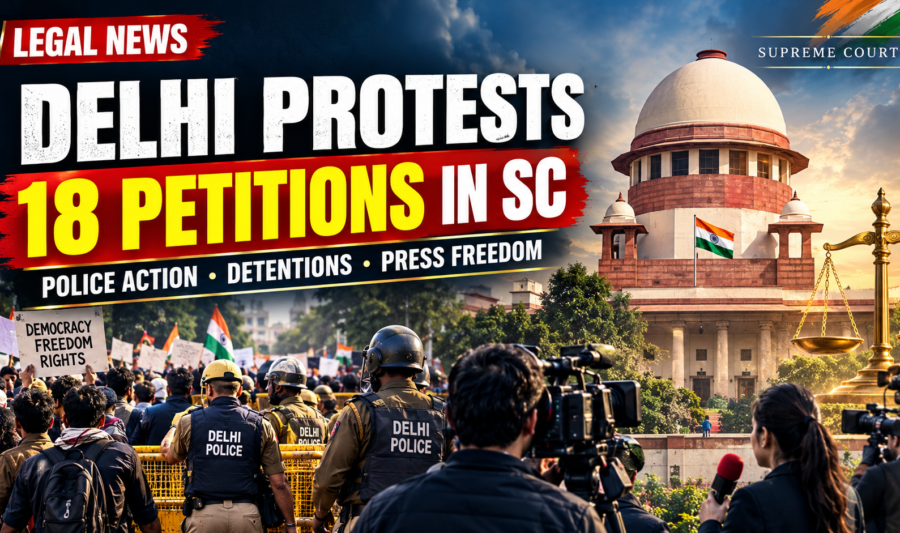
Suggested image alt text: Supreme Court of India petitions concerning Delhi protests, alleged police action and detention of lawyers and journalists.
Suggested social media headline: Delhi Protests: 18 Supreme Court Petitions Raise Concerns Over Detentions, Police Action and Press Freedom
Suggested excerpt: Eighteen petitions and applications linked to the October 10–11 Delhi protests raise questions about alleged police excesses, detention of lawyers and journalists, restrictions on public movement and compliance with Supreme Court directions.
Editorial and copyright note: This article is independently structured and written in original wording based on the supplied case information. It does not reproduce the source article verbatim. Verify case names, petition counts, hearing dates and the latest judicial orders against reliable primary sources before publication. Do not describe allegations as proven facts.
Backlink strategy: Publish this article with a natural, relevant internal link to your own legal-awareness coverage on constitutional rights, unlawful detention, bail procedures, property and civil law, or Supreme Court judgments. For external backlinks, pursue genuine editorial references from legal publications, law-school resources and reputable news websites. Use descriptive, relevant anchor text and avoid paid link schemes, automated backlink services or keyword-stuffed links.