
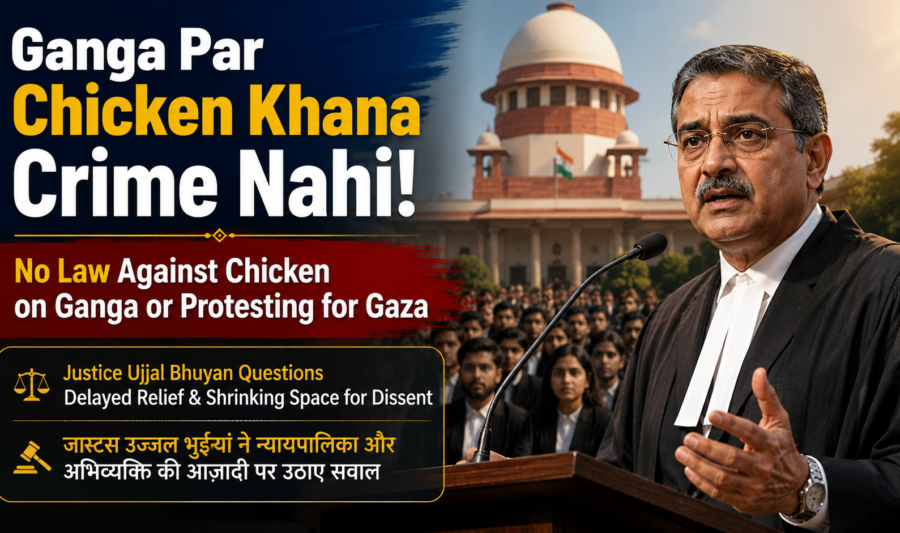
Bhopal, July 26: Supreme Court Justice Ujjal Bhuyan has expressed concern over what he described as the shrinking space for peaceful dissent in India, saying that citizens are increasingly facing criminal action for exercising their constitutional rights to express opinions and protest.
Speaking at a memorial lecture at the National Law Institute University in Bhopal, Justice Bhuyan said that while courts often grant relief to individuals accused in such cases, the relief frequently comes after prolonged delays. He also questioned whether strict bail conditions imposed by courts could discourage people from exercising their democratic freedoms.
“Debate and dissent are the essence of democracy,” Justice Bhuyan said, adding that ordinary activities are increasingly being treated as criminal acts.
Remarks on Chicken Biryani Arrest Case
Referring to a recent incident involving the arrest of a group of Muslim men who were allegedly detained after consuming chicken biryani while breaking their Ramzan fast on a boat in the Ganga, Justice Bhuyan questioned the legal basis for such action.
“I am sure consuming chicken biryani is not an offence. There is no law prohibiting the consumption of chicken over the Ganga river,” he said, noting that the individuals reportedly spent several months in jail before obtaining relief.
He used the case to illustrate broader concerns about criminal proceedings being initiated over activities that do not appear to violate any law.
Concerns Over Restrictive Bail Conditions
Justice Bhuyan also highlighted the increasing use of restrictive bail conditions in certain cases. According to him, conditions such as prohibiting attendance at public meetings, restricting social media activity, or preventing travel abroad may undermine fundamental rights even after bail has been granted.
He questioned whether such conditions indirectly discourage citizens from expressing dissent or participating in peaceful public discourse.
Comments on Gaza Protest Case
The judge also referred to a case in which permission for a public protest concerning the humanitarian situation in Gaza was denied. He said he found it surprising that questions were raised about why Indian citizens would choose to protest over events taking place outside the country.
According to Justice Bhuyan, peaceful demonstrations on issues of global concern are part of democratic expression, and there is no legal prohibition against such protests.
Judiciary Must Welcome Criticism
Justice Bhuyan emphasized that the judiciary should remain open to constructive criticism. He said judicial decisions should be carefully examined and debated by lawyers, students, and scholars, stressing that criticism of a judgment should not be mistaken for criticism of the judge who delivered it.
He encouraged law students to critically analyze important constitutional decisions instead of accepting them without question, arguing that meaningful debate contributes to the development of the legal system.
Public Trust Depends on Self-Reflection
Concluding his address, Justice Bhuyan urged judges to engage in regular introspection if the judiciary is to maintain public confidence.
He observed that the strength and credibility of the courts should ultimately be judged by citizens rather than by the institution itself. According to him, public perception of the judiciary’s fairness, independence, and commitment to constitutional values is essential to preserving its legitimacy.
Justice Bhuyan said that open discussion, accountability, and thoughtful criticism are not threats to the judicial system but are essential for strengthening democratic institutions and protecting constitutional freedoms.