
Can an Agniveer be removed from the Indian Army simply because he did not disclose a criminal case that arose from an incident when he was a minor?
A recent decision of the Armed Forces Tribunal (AFT) has brought this important question into focus.
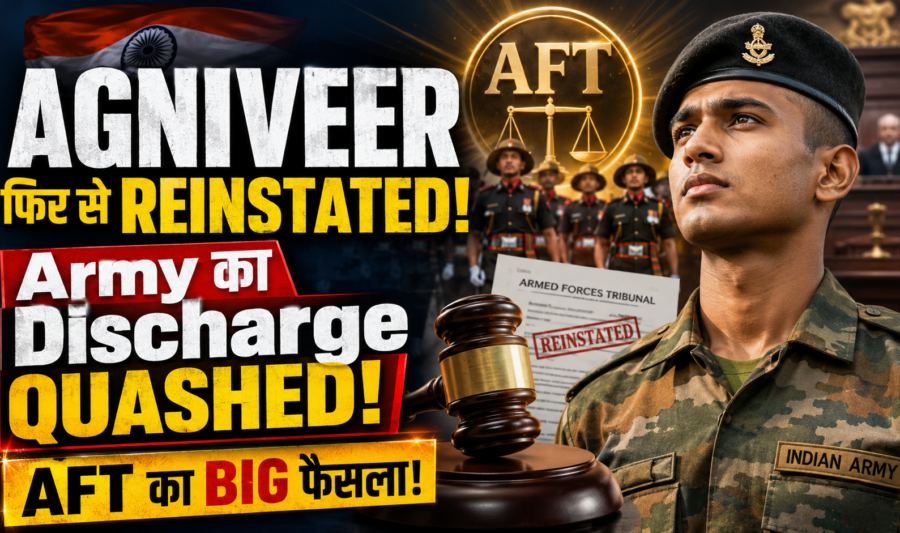
The Tribunal has set aside the discharge of former Agniveer Anas Chauhan and directed the authorities to take him back into service with consequential benefits. The case is significant because the criminal case relied upon by the Army originated from an incident that allegedly took place when Chauhan was around 17 years old.
The Tribunal concluded that, in the circumstances of this case, proceeding against the Agniveer for non-disclosure of that criminal case was “unsustainable in law.” IIndian Express
For professional legal guidance relating to service disputes, employment issues, criminal matters or other legal proceedings, readers can explore VS Advocates Legal, which provides legal consultation and assistance across several areas.
What Happened to the Agniveer?
Anas Chauhan was selected as an Agniveer during the 2024–25 recruitment process after successfully completing the required physical tests.
However, during the subsequent police verification process, an adverse report referred to an FIR registered in Meerut on October 3, 2020.
The FIR reportedly named several individuals, including Chauhan, in connection with a village-related incident.
The crucial point was that Chauhan was allegedly a minor at the time of the incident.
Despite his selection, the Army subsequently issued a show-cause notice in September 2025 concerning the alleged non-disclosure of the criminal case.
The Commanding Officer eventually discharged him from service on January 20, 2026, invoking Item IV of Rule 13(3) of the Army Rules, 1954.
This raised a major legal question:
Can a person be treated as having suppressed criminal antecedents when the underlying incident occurred while that person was a juvenile and a court had already granted protection concerning the case?
Why Did the Army Discharge Him?
The Army’s position was essentially based on the allegation that Chauhan had failed to disclose the pending criminal case in his enrolment documentation.
In military recruitment, verification of antecedents can be extremely important because the armed forces maintain strict standards concerning discipline, integrity and suitability for service.
The Army therefore treated the non-disclosure as a serious issue.
However, Chauhan challenged the decision before the Armed Forces Tribunal.
His legal defence was based on two important aspects:
- The incident occurred when he was a minor.
- The Allahabad High Court had already passed an order concerning the criminal proceedings and his eligibility for the Agniveer recruitment process.
The second point became particularly important in the AFT’s reasoning.
What Did the Allahabad High Court Say?
According to the reported case details, the Allahabad High Court passed an order on April 10, 2025, in proceedings under Section 528 of the Bharatiya Nagarik Suraksha Sanhita (BNSS).
The High Court directed, in substance, that the matter should not be treated as the pendency of a criminal case against the applicant for the purpose of appointment or selection in the Agniveer process.
That protection became a central issue before the Armed Forces Tribunal.
The AFT observed that the High Court’s direction was binding on the authorities.
Therefore, while that protection remained in force, the Army could not simply treat the FIR as an ordinary pending criminal case and use it as the basis for disqualification.
What Did the Armed Forces Tribunal Decide?
The AFT Bench consisted of Chairperson Justice Rajendra Menon and Administrative Member Rasika Chaube.
The Tribunal allowed Chauhan’s application on August 17, 2026 and quashed the Army’s discharge order dated January 20, 2026. IIndian Express
The Tribunal’s reasoning went beyond simply examining whether the Army had followed its internal procedure.
It considered the legal protection available to a person who was a juvenile when the alleged incident occurred.
The Tribunal held that the applicant could not have been proceeded against merely because he had failed to disclose the pendency of the criminal case in the circumstances of this case.
It therefore found the action against him to be legally unsustainable.
Importance of the Juvenile Justice Act
One of the most important aspects of this case is the role of the Juvenile Justice (Care and Protection of Children) Act, 2000.
The juvenile justice framework is based on the principle that children who come into conflict with law should not necessarily carry the same consequences into their adult lives as an adult offender.
The AFT relied upon the Juvenile Justice Act along with judicial precedents to reinforce the principle that involvement in an offence during childhood cannot automatically become a permanent barrier to employment.
This is particularly significant in recruitment cases.
A young person may have been involved in an incident at the age of 16 or 17, but that does not necessarily mean that the incident can later be treated in exactly the same manner as an adult criminal antecedent.
Why This Judgment Matters for Agniveers
The decision is important because the Agniveer recruitment system involves strict verification of candidates.
Candidates are generally expected to provide accurate information during recruitment and enrolment.
But this case highlights an important legal distinction:
Not every omission concerning an old criminal case can automatically be treated as misconduct or suppression.
The surrounding circumstances matter.
The candidate’s age at the time of the incident, the nature of the case, the orders passed by constitutional courts and the applicable statutory protections can all become relevant.
Therefore, this judgment should not be understood as saying that an Agniveer can freely conceal criminal cases.
Rather, the decision is about the particular legal circumstances surrounding a minor-era case and an existing High Court protection.
What About Rule 13(3) of the Army Rules?
The Army had relied upon Item IV of Rule 13(3) of the Army Rules, 1954 for the discharge.
This provision was therefore directly relevant to the dispute.
However, the existence of a power to discharge does not necessarily mean that the power can be exercised without considering other binding legal protections.
The AFT essentially held that the Army’s action could not stand when viewed against the High Court’s protection and the legal principles applicable to juvenile involvement.
In simple terms:
Administrative power must operate within the boundaries of applicable law and binding judicial orders.
For people facing termination, discharge, disciplinary action or other service-related disputes, professional advice can be important because the outcome may depend on the exact service rules, orders and facts involved. Legal consultation for service matters, termination, employment disputes and related proceedings is among the areas listed by VS Advocates Legal.
The Tribunal’s Key Observation
One of the strongest aspects of the decision was the Tribunal’s conclusion that the applicant could not be proceeded against for non-disclosure of the criminal case in the circumstances before it.
The Tribunal also indicated that if the Army believed that the Allahabad High Court’s order did not extend to the alleged non-disclosure in the enrolment form, the appropriate course would have been to approach the High Court for clarification or modification.
In other words, the Army could not simply disregard or independently narrow the effect of an existing judicial protection.
That principle has significance beyond this particular Agniveer case.
Does This Mean Every Agniveer With an FIR Is Protected?
No.
This is perhaps the most important point to understand.
The judgment does not create a blanket rule that every Agniveer who has an FIR can avoid disclosure or cannot be discharged.
Each case will depend upon its own facts and the applicable law.
For example, important questions may include:
- When did the alleged incident take place?
- How old was the candidate at that time?
- What was the nature of the allegation?
- Was the person dealt with under juvenile justice law?
- What exactly did the recruitment or enrolment form require?
- Was there a court order protecting the candidate?
- Was the court order still operative?
- Did the candidate deliberately provide false information?
- What service rule was invoked by the authorities?
- Was the authority bound by a previous judicial direction?
Therefore, candidates should not assume that this judgment automatically protects every case involving non-disclosure.
What Are the Consequences of the AFT Order?
The Tribunal did not merely declare the discharge unlawful.
It directed the respondents to take Chauhan back into Agniveer service pursuant to the appointment already issued to him, in accordance with law and with consequential benefits. IIndian Express
This makes the decision particularly significant.
The practical effect is that the earlier discharge order has been quashed and the authorities have been directed to restore the applicant to service subject to the legal conditions mentioned in the Tribunal’s order.
The Tribunal also clarified that the relief would remain subject to any subsequent order passed by the Allahabad High Court if the Centre seeks clarification or modification of the protection granted earlier.
Bigger Legal Issue: Juvenile Record vs. Future Employment
The case raises a broader question about how India’s legal system should treat juvenile incidents when a person later seeks government employment.
The juvenile justice system is not designed merely to punish.
It also aims at rehabilitation and reintegration.
If an incident from a person’s childhood could permanently prevent that individual from obtaining employment, education or public opportunities even after the person has entered adulthood, it could undermine the rehabilitative philosophy behind juvenile justice.
The AFT’s decision therefore demonstrates how juvenile justice principles can interact with government recruitment and service law.
What Should Candidates Do If They Have a Past FIR?
Anyone applying for a government job, armed forces recruitment or another regulated position should be extremely careful when completing forms relating to criminal antecedents.
Do not assume that an old FIR is automatically irrelevant.
At the same time, do not assume that every FIR automatically makes you ineligible.
The safest approach is to examine the exact wording of the recruitment form and the legal status of the case.
If there is an existing court order, acquittal, quashing order, juvenile justice proceeding or other legal protection, keep certified copies and supporting documents safely available.
If a candidate is facing discharge, termination or adverse action because of alleged non-disclosure, the matter should be examined on its specific facts and under the applicable service rules.
For legal consultation relating to criminal matters, service matters, employment disputes and other legal issues, you can visit VS Advocates Legal.
Key Takeaways From the AFT Agniveer Case
- Anas Chauhan was selected as an Agniveer during the 2024–25 recruitment process.
- An FIR registered in Meerut in 2020 became an issue during police verification.
- The alleged incident occurred when Chauhan was a minor.
- The Army discharged him on January 20, 2026, citing alleged suppression of information.
- The AFT considered the protection granted by the Allahabad High Court.
- The Tribunal also considered the Juvenile Justice Act and relevant judicial precedents.
- The AFT allowed Chauhan’s application on August 17, 2026.
- The discharge order was quashed.
- The authorities were directed to take him back into Agniveer service with consequential benefits.
- The relief remains subject to any subsequent order of the Allahabad High Court.
Final Legal Analysis
The Anas Chauhan case is an important reminder that military discipline, recruitment requirements and juvenile justice protections must operate consistently with one another.
The armed forces have legitimate requirements concerning integrity, discipline and verification of candidates. At the same time, administrative decisions cannot ignore statutory protections or binding judicial orders.
The central lesson from the AFT decision is therefore not that disclosure requirements are unimportant.
Rather, it is that the law must examine the circumstances in which an alleged non-disclosure occurred.
Where the underlying incident relates to a person’s childhood and a competent court has already granted specific protection concerning the criminal case, authorities must carefully consider that protection before taking adverse employment action.
For Agniveers and other government-job aspirants facing legal or service-related difficulties, understanding the exact legal position is critical.
For further legal information and consultation, visit VS Advocates Legal.
Disclaimer: This vlog is intended for general legal awareness and informational purposes only. It is based on publicly reported facts concerning the AFT decision and should not be treated as legal advice for any individual case. Legal outcomes depend on the facts, documents, applicable rules and orders of the competent courts or tribunals.
SEO package
SEO Title:
AFT Reinstates Agniveer: Major Legal Relief Over Minor-Era FIR & Non-Disclosure
Meta Description:
Armed Forces Tribunal reinstates Agniveer Anas Chauhan after quashing his discharge over alleged non-disclosure of a minor-era FIR. Know the legal reasoning, Juvenile Justice Act and impact on Agniveer recruitment.
Primary Keywords:
AFT Agniveer case, Agniveer reinstatement, Armed Forces Tribunal Agniveer, Anas Chauhan case, Agniveer discharge, Agniveer FIR case, minor criminal case employment, Juvenile Justice Act employment, Indian Army Agniveer case