

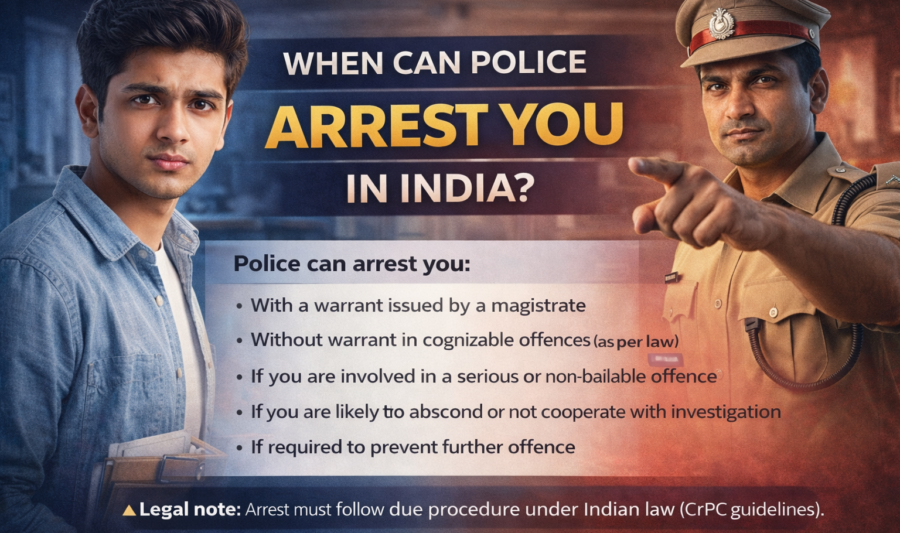
Understanding when police can arrest a person in India is essential for legal awareness and protection of individual rights. Arrest is governed by the Code of Criminal Procedure, 1973 (CrPC) along with judicial guidelines issued by courts.
An arrest cannot be made arbitrarily. It must follow legal procedure, reasonable grounds, and statutory safeguards.
What is Arrest Under Indian Law?
Arrest refers to the act of taking a person into custody by legal authority, usually by the police, in connection with a criminal offence.
It involves restriction of personal liberty, and therefore, it must comply with the provisions of law.
When Can Police Arrest You? (As Per Law)
1. Arrest With Warrant (CrPC Section 72–74)
Police can arrest a person when a warrant is issued by a magistrate.
This usually happens in non-cognizable or serious matters where court permission is required.
2. Arrest Without Warrant (CrPC Section 41)
Police may arrest without a warrant in cognizable offences, where:
- A person is involved in a serious offence
- There is reasonable suspicion or credible information
- The offence is punishable with imprisonment
- Arrest is necessary for proper investigation
3. Preventive Arrest (CrPC Section 151)
Police may arrest a person to prevent the commission of a cognizable offence, if there is a reasonable belief that such offence may occur.
4. Non-Cooperation or Absconding Risk
Police may arrest if:
- The person is not cooperating with investigation
- There is a risk of absconding (escaping)
- The person may tamper with evidence or influence witnesses
5. Identity Not Verified (CrPC Section 41(1)(b))
If a person’s identity cannot be verified, police may detain or arrest to confirm identity.
Important Supreme Court Guidelines
In Arnesh Kumar vs State of Bihar (2014), the Supreme Court held:
- Arrest should not be automatic
- Police must justify the necessity of arrest
- Notice of appearance (Section 41A CrPC) should be preferred in certain cases
Your Legal Rights at the Time of Arrest
Every individual has the following rights:
- Right to know the reason for arrest (Article 22 of Constitution)
- Right to legal representation
- Right to inform a family member or friend
- Right to be produced before a magistrate within 24 hours
- Right against unlawful detention
Procedure Police Must Follow
As per law and D.K. Basu Guidelines, police must:
- Identify themselves clearly
- Prepare an arrest memo
- Inform grounds of arrest
- Maintain proper documentation
- Avoid unnecessary force
When Police Cannot Arrest Arbitrarily
Police cannot arrest:
- Without reasonable grounds
- In a non-cognizable offence without court permission
- Just based on complaint without verification
- Without following due procedure
Conclusion
Arrest is a serious legal action and must be exercised with caution and in accordance with law. Understanding CrPC provisions, Supreme Court guidelines, and individual rights helps citizens stay informed and protected.
Legal awareness ensures that individuals can respond appropriately and lawfully in such situations.
- when police can arrest you in India
- arrest without warrant India
- CrPC Section 41 explained
- police arrest rules India
- legal rights during arrest India
- preventive arrest law India
- Supreme Court arrest guidelines
- criminal law India