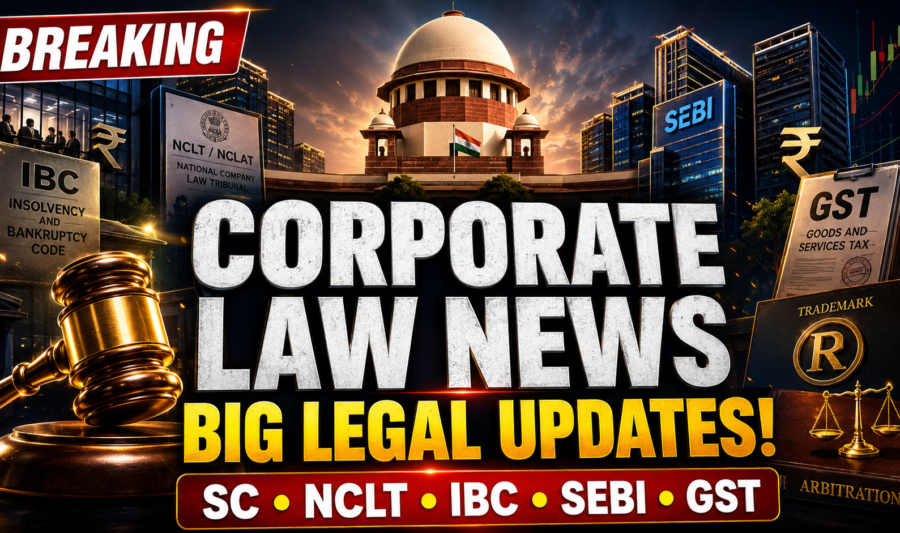
Corporate Legal News | September 1, 2026: India’s corporate and commercial legal landscape witnessed several significant developments across insolvency, taxation, intellectual property, arbitration, securities regulation, banking and real estate law.
From the Supreme Court examining the scope of enforcement action during an IBC moratorium to important NCLT developments involving repayment plans, mergers and insolvency proceedings, courts and regulatory authorities delivered several decisions with potential implications for companies, investors, creditors and financial institutions.
Here is a comprehensive roundup of the key corporate legal developments.
IBC and Insolvency Law
Supreme Court Issues Notice on ED Action During IBC Moratorium
The Supreme Court has issued notice on a challenge concerning an NCLAT ruling that permitted enforcement action by the Enforcement Directorate (ED) during the moratorium period under the Insolvency and Bankruptcy Code.
The matter raises an important legal question concerning the interaction between insolvency proceedings and powers exercised under financial and anti-money-laundering laws.
The Supreme Court’s examination could have significant implications for insolvency professionals, resolution applicants, creditors and companies undergoing corporate insolvency resolution.
NCLAT Delhi to Hear Appeal Against Subhash Chandra Repayment Plan
The NCLAT, New Delhi, is set to hear an appeal relating to a repayment plan associated with businessman Subhash Chandra, involving approximately ₹6.5 crore.
The dispute comes amid continuing judicial scrutiny of the repayment arrangement and the orders passed by the National Company Law Tribunal.
NCLT Delhi Stays Approval of Subhash Chandra Repayment Plan
In another significant development, a newly constituted five-member NCLT Delhi Bench has stayed an earlier order approving a repayment plan involving approximately ₹6.25 crore.
The development follows proceedings concerning the absence of a majority on the earlier bench and highlights the importance of judicial consistency in insolvency and repayment-plan proceedings.
NCLT Kochi Waives Meetings in Vallabhdas Kanji Amalgamation
The NCLT Kochi has waived the requirement of convening meetings in connection with a proposed amalgamation involving Vallabhdas Kanji and three wholly owned subsidiaries.
The order is relevant to corporate restructuring and merger proceedings, particularly where the statutory requirements for stakeholder meetings may be addressed through the tribunal’s powers.
NCLT Delhi Refers Subhash Chandra Plan to Five-Member Bench
The NCLT Delhi has referred the Subhash Chandra repayment-plan matter to a five-member Bench after the earlier Bench failed to reach a majority.
The matter has attracted attention because of the value of the repayment arrangement and the procedural questions surrounding its approval.
Intellectual Property Rights
Madras High Court Rejects Vinbros Plea Over ‘Blue Grape’ Trademark
The Madras High Court has rejected a plea by Vinbros seeking to initiate proceedings against competitors concerning the use of the ‘Blue Grape’ trademark.
The case highlights the importance of establishing a legally protectable trademark interest and satisfying the requirements for obtaining judicial relief in trademark disputes.
Delhi High Court Restrains Hotel From Using ‘HILTON’ Marks
The Delhi High Court has restrained a hotel from using the marks ‘HILTON’ and ‘HOTEL HILTON INDIA’.
The order underscores the protection available to established trademarks against potentially confusing or unauthorised commercial use.
Trademark owners facing infringement disputes should carefully evaluate registration, prior use, reputation and evidence of consumer confusion before pursuing litigation.
YouTube Disparagement Case: Madras HC Refuses Summary Dismissal
The Madras High Court has declined to accept YouTube’s plea seeking summary dismissal in a dispute involving alleged disparagement concerning Sri Eshwar College.
The proceedings raise questions concerning online content, platform liability and the legal standards applicable to allegations of disparagement in digital media.
Supreme Court Stays Swiss Company’s Patent Proceedings
The Supreme Court has stayed a Swiss company’s patent litigation against Techfab that was pending before the Himachal Pradesh High Court.
The development places the patent dispute under the Supreme Court’s scrutiny and may have implications for the parties’ ongoing intellectual-property litigation strategy.
Copyright Office: AI System DABUS Cannot Be Author
In an important development concerning artificial intelligence and intellectual property law, the Copyright Office has stated that the AI system DABUS cannot be recognised as an ‘author’ under Indian copyright law.
The issue is part of a much larger international debate over whether works generated by artificial intelligence can receive copyright protection and, if so, who should legally be treated as the author.
As generative AI becomes increasingly important to businesses, advertising agencies, software companies and content creators, questions surrounding ownership and authorship are likely to become increasingly significant.
For businesses seeking legal assistance concerning intellectual property, corporate matters and technology-related legal issues, VS Advocates Legal provides legal information and consultation services.
Tax and GST Law
Rajasthan High Court Sets Aside Unsigned GST Notice
The Rajasthan High Court has set aside an unsigned GST notice along with a demand of approximately ₹3.13 lakh against Mayur Timber.
The decision highlights the importance of statutory compliance and procedural validity in tax proceedings.
A notice issued by a tax authority must satisfy the applicable legal and procedural requirements. Defects in statutory notices can become significant when taxpayers challenge assessment or demand proceedings before constitutional courts.
ITAT Delhi Quashes Reassessment Based on Existing Information
The Income Tax Appellate Tribunal (ITAT), New Delhi, has quashed a reassessment proceeding where the information relied upon by the tax department was already available on the existing record.
The ruling reinforces the importance of the legal requirements governing reassessment and the distinction between genuinely new information and material that was already before the assessing authority.
Company Law
NCLT Indore Approves Second Motion in HEG-Bhilwara Energy Restructuring
The NCLT Indore has admitted the second motion in a composite scheme involving the demerger of HEG and the merger of Bhilwara Energy.
Corporate restructuring through demergers and mergers requires careful compliance with the Companies Act and tribunal procedures.
Such schemes can have significant implications for shareholders, creditors, employees and the resulting corporate structure.
Arbitration Law
Permanent Court of Arbitration Examines India’s Indus Waters Treaty Position
The Permanent Court of Arbitration has addressed India’s position concerning the country’s decision to place the Indus Waters Treaty in abeyance.
The dispute has major international-law and arbitration implications and remains closely watched because of the treaty’s significance for India-Pakistan water relations.
Delhi HC Orders Forensic Audit in Daiichi-Fortis Dispute
The Delhi High Court has ordered a forensic audit concerning allegations surrounding the dissipation of Fortis shares in connection with the long-running Daiichi arbitration dispute.
The order demonstrates the role of courts in preserving and tracing assets where allegations arise concerning enforcement of arbitral awards and potential dissipation of property.
Supreme Court to Examine Interim Monetary Relief by Arbitral Tribunals
The Supreme Court is set to consider whether an arbitral tribunal has the authority to grant interim monetary relief concerning disputed claims.
The question is important for commercial arbitration because interim relief can play a crucial role in protecting parties’ financial interests while the underlying dispute remains unresolved.
The Supreme Court’s ruling could provide greater clarity concerning the scope of arbitral powers.
Securities Law
SEBI Penalises Citrus Check Inns Directors
The Securities and Exchange Board of India has penalised three directors of Citrus Check Inns over continued investor collections allegedly made after a regulatory prohibition.
The action highlights SEBI’s continuing focus on investor protection and compliance with regulatory directions.
Companies and directors involved in fundraising activities must ensure strict compliance with securities regulations and regulatory orders.
RERA and Real Estate Law
Bombay High Court: RERA Tribunal Can Restore Proceedings Dismissed for Default
The Bombay High Court has held that a RERA Appellate Tribunal possesses inherent power to restore proceedings that were dismissed for default.
The ruling is important for litigants involved in real-estate disputes because dismissal for non-appearance or default can have serious consequences.
The recognition of restorative powers may provide an avenue for parties to seek revival of proceedings where sufficient grounds exist.
Competition Law
CCI Closes Complaint Against CCA Over FIPS 140-3 Upgrade
The Competition Commission of India has closed a complaint against the Controller of Certifying Authorities (CCA) concerning allegations that the FIPS 140-3 upgrade process favoured Precision Biometric.
The matter involved allegations relating to competition and potential preferential treatment.
The closure represents another development in the intersection between regulatory standards, certification requirements and competition law.
Banking and NBFC
RBI Appoints Suman Ray as Executive Director
The Reserve Bank of India (RBI) has appointed Suman Ray as Executive Director with effect from September 1, 2026.
The appointment is part of the RBI’s senior leadership structure and comes into effect from the beginning of the month.
Changes at the executive level of India’s central bank are closely watched by the banking and financial-services sector.
Other Major Corporate Legal Developments
Supreme Court Allows HDFC Bank and Former Trustee Intervention in Lilavati Case
The Supreme Court has declined to interfere with a Bombay High Court order permitting HDFC Bank and a former trustee to intervene in the Lilavati-related proceedings.
The dispute has attracted attention because of the competing legal and financial interests surrounding the matter.
Nimmagadda Prasad Directed to Furnish Additional ₹200 Crore Security
The Supreme Court has directed businessman Nimmagadda Prasad to furnish an additional security amount of approximately ₹200 crore in connection with the RAKIA decree matter.
The order represents a significant development in proceedings concerning enforcement and financial security.
Why These Corporate Legal Developments Matter
The developments reported on September 1 demonstrate how rapidly India’s corporate legal environment is evolving.
For businesses, the most important themes include:
- IBC and insolvency: The relationship between insolvency proceedings and enforcement powers remains an important area of litigation.
- Corporate restructuring: Merger and demerger schemes continue to require careful tribunal scrutiny.
- Intellectual property: Trademark, patent, copyright and AI-related disputes are becoming increasingly important for businesses.
- Tax litigation: Procedural validity remains a critical component of GST and income-tax disputes.
- Arbitration: Questions surrounding interim relief and enforcement continue to shape India’s commercial arbitration framework.
- Securities regulation: SEBI continues to take action concerning investor protection and regulatory compliance.
- Real estate: RERA litigation remains an important area for developers, homebuyers and investors.
- Banking: RBI appointments and regulatory developments can have wider implications for the financial sector.
Conclusion
September 1, 2026 saw a broad range of important developments across India’s corporate legal ecosystem.
The Supreme Court’s involvement in questions concerning the IBC moratorium, arbitration powers and major commercial disputes, alongside developments before the NCLT, NCLAT, High Courts, SEBI, CCI, RBI and RERA authorities, demonstrates the continuing evolution of India’s business-law framework.
For companies, investors, directors, creditors and entrepreneurs, staying updated with these developments is essential because court decisions and regulatory orders can directly influence commercial strategy, compliance obligations and litigation risk.
For legal consultation relating to corporate law, commercial disputes, insolvency, taxation, intellectual property, arbitration, employment and other legal matters, visit VS Advocates Legal.
Disclaimer: This article is intended for general legal and informational purposes only. It does not constitute legal advice. Readers should consult a qualified legal professional regarding the specific facts and circumstances of their matter.