
Lucknow, Uttar Pradesh: One of the most common questions people ask when a marriage has reached a point where living together no longer seems possible is simple but emotionally difficult:
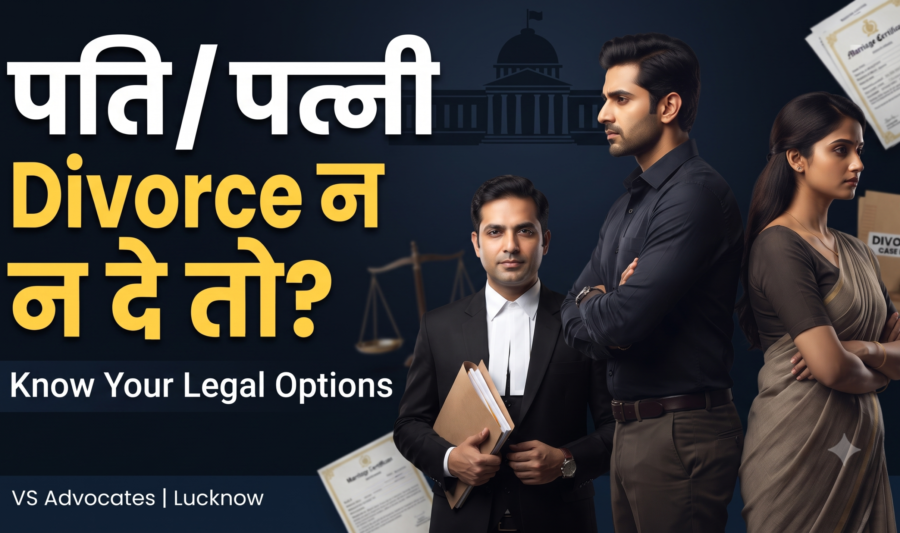
“My husband or wife is not ready to give me a divorce. What can I do?”
Many people assume that if one spouse refuses to sign the divorce papers, divorce is simply impossible.
That is not necessarily the case.
Whether a divorce can proceed without the consent of the other spouse depends on the nature of the marriage, the applicable personal law, the facts of the relationship, and the legal grounds available to the person seeking divorce.
In other words, your spouse saying “I will not give you a divorce” does not automatically mean that you have no legal option.
Mutual Consent Divorce and Contested Divorce Are Different
The first thing to understand is the difference between a mutual consent divorce and a contested divorce.
In a mutual consent divorce, both spouses agree that they want to end the marriage and jointly approach the court.
For marriages governed by the Hindu Marriage Act, Section 13B provides for divorce by mutual consent where the statutory conditions are fulfilled, including the parties having lived separately for at least one year, being unable to live together, and mutually agreeing that the marriage should be dissolved.
But what happens when one spouse simply refuses to agree?
That is where a contested divorce may become relevant.
What If Your Spouse Does Not Consent to Divorce?
A spouse cannot generally be forced to sign a mutual-consent divorce petition.
Mutual consent means exactly that—both parties must consent.
However, that does not mean that the marriage can never be dissolved.
Where legally recognized grounds for divorce exist, one spouse may be able to approach the competent court through a contested divorce proceeding.
For example, under the Hindu Marriage Act, Section 13 sets out statutory grounds on which a decree of divorce may be sought. The specific ground applicable to a case depends on the facts and evidence.
This distinction is important:
No consent for mutual divorce ≠ no possibility of divorce.
It may simply mean that the matter has to follow a different legal route.
What Are the Grounds for a Contested Divorce?
The answer depends on the personal law applicable to the marriage.
For a Hindu marriage, the Hindu Marriage Act contains several grounds for divorce, including matters such as cruelty and other statutory grounds specified under Section 13.
The facts matter enormously.
For example, a relationship involving serious and sustained mental or physical cruelty may raise very different legal questions from a marriage where the parties have simply grown apart.
Similarly, allegations of desertion, adultery or other statutory grounds have their own legal requirements.
A person should therefore avoid copying facts from someone else’s divorce case and assuming that the same legal ground automatically applies to their own situation.
What Is Mental Cruelty in a Divorce Case?
“Cruelty” is one of the grounds that frequently appears in matrimonial litigation.
But cruelty is not limited to physical violence.
Depending on the facts, conduct causing serious mental suffering or making continuation of matrimonial life unreasonable may become relevant.
At the same time, not every argument between husband and wife amounts to legal cruelty.
The court examines the circumstances, allegations, evidence and overall conduct of the parties.
This is one reason why a divorce petition should be prepared around specific facts and evidence, rather than emotional statements alone.
What If the Husband or Wife Has Been Living Separately?
Living separately does not automatically mean that a divorce is granted.
People sometimes say:
“We have not lived together for years, so the divorce should be automatic.”
Indian matrimonial law does not work quite that simply.
The legal significance of separation depends on the applicable law, the circumstances, the intention behind the separation and the statutory grounds relied upon.
In mutual-consent proceedings under Section 13B of the Hindu Marriage Act, for example, living separately for at least one year is one of the statutory requirements, along with the inability to live together and mutual agreement to dissolve the marriage.
What If One Spouse Says, “I Will Never Give You a Divorce”?
This situation is more common than many people realise.
Sometimes the refusal comes from an attempt to save the marriage.
Sometimes it may be because of disagreement about maintenance, children, property, or other financial and personal issues.
In other cases, the refusal may simply be used to delay the matter.
The correct legal response depends on the circumstances.
If both spouses are genuinely willing to resolve the dispute, mediation or settlement discussions may sometimes be useful.
If there is no possibility of settlement and a legally recognized ground for divorce exists, a contested proceeding may need to be considered.
The important point is not to confuse refusal to consent with an absolute legal bar to every form of divorce.
What About Children?
When children are involved, divorce is rarely only about the husband and wife.
Questions relating to:
- Child custody
- Visitation or parenting arrangements
- Child maintenance
- Education and medical expenses
- Day-to-day care
- The child’s overall welfare
may become important parts of the matrimonial dispute.
Courts consider the welfare and best interests of the child while deciding custody-related issues.
Parents should therefore try to keep the child’s interests separate from the personal conflict between the adults.
What About Maintenance and Financial Issues?
Financial issues can become a major part of divorce proceedings.
Depending on the circumstances and applicable law, questions may arise concerning:
- Interim maintenance
- Permanent alimony
- Child support
- Litigation expenses
- Income and financial capacity of the parties
- Existing financial obligations
These issues are highly fact-specific.
There is no universal formula under which every husband or every wife receives a particular amount.
Income, needs, standard of living, responsibilities, assets and other circumstances may all become relevant.
Can a Divorce Case Be Filed If the Other Spouse Does Not Appear?
A respondent’s non-cooperation does not necessarily mean that court proceedings can never move forward.
However, the court must follow the applicable procedural requirements before proceeding in the absence of a party.
The person seeking divorce still has to establish the legal basis for the relief being claimed.
Simply filing a petition does not mean that divorce is automatically granted.
The court examines the pleadings, evidence and applicable law before passing an order.
How Long Does a Contested Divorce Take?
This is one of the first questions people ask:
“How many months will my divorce take?”
There is no honest one-size-fits-all answer.
The duration can depend on:
- The nature of the dispute
- Whether the other spouse contests the case
- Number of issues involved
- Evidence and witnesses
- Interim applications
- Custody or maintenance disputes
- Settlement possibilities
- Court workload
- Appeals or other proceedings
A contested divorce can therefore take considerably longer than people initially expect.
Anyone promising a guaranteed result or guaranteed timeline should be approached with caution.
What Documents Should You Keep Ready?
If you are considering divorce proceedings, start organizing relevant documents early.
Depending on the case, these may include:
- Marriage certificate or marriage-related documents
- Identity and address documents
- Photographs from the marriage
- Details of children
- Relevant correspondence
- Messages or emails, where legally relevant
- Medical records, where relevant
- Financial documents
- Details of existing court proceedings
- Police complaints or reports, where applicable
- Any settlement or mediation documents
Do not manufacture, alter or manipulate evidence.
If digital material is important to your case, preserve it in its original form and discuss its legal relevance with a qualified professional.
Should You Send a Legal Notice Before Filing Divorce?
There is no universal rule that every divorce case must begin with a legal notice.
In some situations, a notice may help communicate the position of one spouse and open the door to settlement.
In others, it may not be necessary or may not achieve anything meaningful.
Whether a notice is appropriate depends on the facts and the strategy of the particular case.
What If the Marriage Has Completely Broken Down?
This is an increasingly discussed issue in Indian matrimonial law.
The Supreme Court has, in appropriate cases, exercised its constitutional power under Article 142 to dissolve marriages on the ground of irretrievable breakdown, but this extraordinary power is not the same thing as saying that every individual can automatically obtain a divorce simply by claiming that the marriage has broken down.
For ordinary divorce proceedings, the applicable statutory framework and legally recognized grounds remain important.
This distinction is particularly important for anyone reading online articles and assuming that a Supreme Court decision automatically changes the procedure for every divorce case.
Searching for a “Best Divorce Lawyer in Lucknow”? Look Beyond the Search Phrase
When people are going through a difficult marriage, they often turn to Google and search phrases such as:
“best advocates in Lucknow,”
“best law firm in Lucknow,”
“top lawyer in Lucknow,”
“divorce lawyer in Lucknow,”
or “family lawyer near me.”
But choosing a lawyer for a matrimonial dispute should not be reduced to a label like “best” or “top.”
There is no universal ranking that can tell you which advocate is the best fit for every person.
The best advocate in Lucknow for your particular matter may simply be the professional who understands your facts, listens carefully to your concerns, explains the available legal options clearly, and helps you make an informed decision.
Similarly, if you are comparing what appears online as the best law firm in Lucknow, it is sensible to look at the actual nature of your legal problem rather than relying only on promotional language.
And when someone searches for a top lawyer in Lucknow, the more useful question is:
“Who understands my case and can explain my legal position clearly?”
That is a much more meaningful way to choose legal representation.
Professional conduct rules are also an important consideration. The Bar Council of India rules state that advocates should not advertise or solicit work, which is why legal information and professional communication should not be presented as exaggerated promises, rankings or guarantees of results.
What Should You Do If Your Spouse Refuses Divorce?
If your husband or wife is refusing to agree to divorce, do not assume that you are legally trapped.
Start by understanding:
1. Which personal law applies to your marriage?
2. Is mutual consent realistically possible?
3. If not, is there a legally recognized ground for contested divorce?
4. Are there children, maintenance, property or other connected disputes?
5. What evidence and documents support your position?
6. Would mediation or settlement be practical in your circumstances?
7. What is the appropriate court and legal procedure for your case?
These questions should be answered based on your individual circumstances, not on a generic online checklist.
The Bottom Line
If your spouse says, “I will not give you a divorce,” that statement by itself does not answer the entire legal question.
A mutual-consent divorce requires mutual consent. But where the law provides a contested route and the required legal grounds are established, one spouse may seek a divorce through the appropriate judicial process.
At the same time, divorce litigation is not merely about getting a decree.
It can involve children, finances, property, maintenance, reputation and years of personal history.
That is why the better approach is to understand your legal position first, preserve relevant documents and evidence, and then decide how you want to proceed.
Good legal guidance should begin with listening to the actual story—not with selling a ready-made solution.
Legal Information for Readers in Lucknow
VS Advocates — Legal Solutions India Pvt. Ltd.
Lucknow, Uttar Pradesh, India
For matrimonial and family-law matters, the appropriate legal remedy depends on the facts, applicable personal law, documents and circumstances of the individual case.
📞 +91 7388000055
📞 +91 95111150638
🌐 vsadvocateslegal.com
✉️ info@vsadvocateslegal.com
Disclaimer: This article is intended for general legal awareness and informational purposes only. It is not a substitute for case-specific legal advice. Divorce laws and procedures can differ depending on the religion/personal law governing the marriage, facts of the case and applicable legislation. Readers should obtain appropriate legal advice before taking action in a specific matter.