
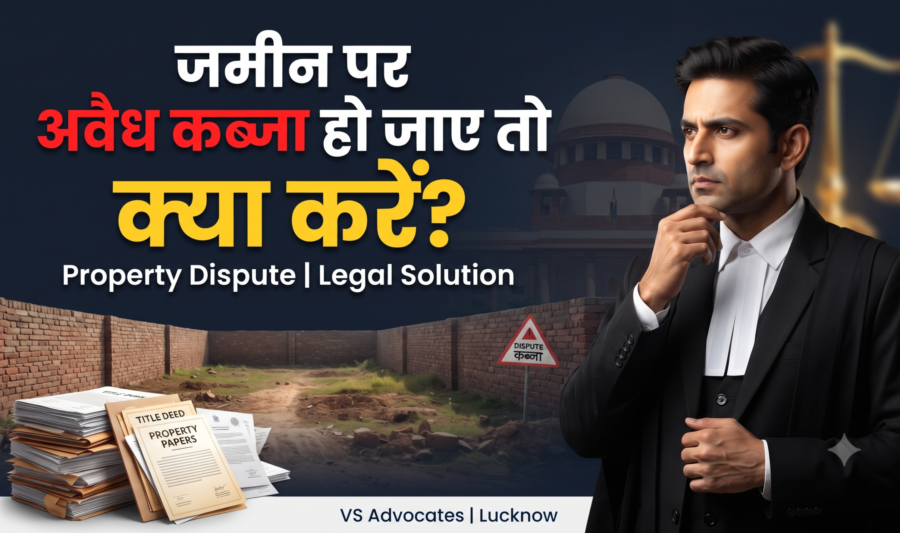
Lucknow, Uttar Pradesh: For many people, land is not simply another asset. It may be the result of years of savings, a family inheritance, or property purchased with the intention of building a home or securing the future of the family.
That is why discovering that someone has entered your land, raised a boundary wall, started construction, or simply taken possession without your consent can be extremely stressful.
The first reaction is often anger: “This is my land. I will remove them myself.”
Legally, however, that may not be the safest approach.
Property disputes in India are generally required to be dealt with through lawful procedures. The Supreme Court has repeatedly emphasized that a person in settled possession cannot simply be forcibly dispossessed by another person taking the law into their own hands; the appropriate remedy may require recourse to a competent court.
So, what should you actually do if someone has illegally occupied your land?
First, Understand What “Illegal Possession” Actually Means
Not every property dispute is the same.
A person may have entered the property without permission. Someone may have extended a boundary onto your land. A relative may be claiming ownership over inherited property. A tenant or licensee may have refused to vacate. In another situation, two people may each have documents claiming rights over the same piece of land.
These situations can involve different legal questions.
The first step is therefore to establish:
- Who is the recorded owner?
- What documents establish title?
- Who was in actual possession?
- When did the alleged encroachment or occupation begin?
- How did the other person enter the property?
- Is there any sale deed, agreement, lease, family settlement, inheritance document or other document involved?
- Are the revenue records consistent with the title documents?
- Has any construction taken place?
- Is a boundary dispute involved?
- Has any previous litigation taken place concerning the property?
These details can significantly affect the legal remedy.
What Should You Do Immediately?
1. Do Not Try to Evict the Occupant by Force
This is one of the most important practical points.
Even if you genuinely believe that the land belongs to you, physically removing another person, demolishing a structure yourself, threatening the occupants, or using force can create a second legal problem.
The Supreme Court has explained that settled possession is not ordinarily to be disturbed through force and that possession disputes should be addressed through due process of law.
In simple words:
Do not turn a property dispute into a criminal or personal confrontation. Build your legal case instead.
2. Collect Every Property Document You Have
Before approaching anyone, gather your documents.
Depending on the nature of the property, these may include:
- Sale deed
- Gift deed
- Partition deed
- Will and succession-related documents
- Family settlement
- Lease documents
- Mutation records
- Revenue records
- Property tax records
- Previous agreements
- Possession-related documents
- Approved maps or site plans
- Photographs and videos
- Previous notices or correspondence
- Earlier court orders, if any
Do not assume that one document alone will settle every issue.
A property dispute may involve questions of title, possession, boundaries, inheritance, mutation and limitation, and these questions need to be examined together.
3. Preserve Evidence of the Encroachment
If someone has recently entered the property or started construction, document the situation carefully.
Take dated photographs and videos where appropriate. Preserve messages, notices, correspondence and other relevant records. If there are witnesses who have direct knowledge of the possession or boundary situation, keep their details safely.
If a boundary has been altered, documents relating to the original boundary and a proper site measurement may become particularly important.
The objective is simple:
Do not rely only on memory. Preserve evidence.
4. Check the Revenue and Property Records
A common mistake in land disputes is assuming that a particular revenue entry automatically proves complete ownership.
Revenue records can be important, but the legal significance of each record depends on the facts and nature of the dispute.
The underlying title documents, chain of ownership, possession and other evidence may also need to be examined.
This is why a document-by-document review is often more useful than simply asking, “Whose name is on the record?”
5. Consider a Legal Notice Where Appropriate
Depending on the facts, a legal notice may be one of the steps available before or alongside court proceedings.
A properly drafted notice can:
- State your claim clearly
- Identify the disputed property
- Record your objection to the alleged encroachment
- Demand appropriate action
- Create a documentary record of the dispute
- Provide an opportunity for the other side to respond
However, sending a notice does not automatically guarantee that the other party will vacate the property.
If the dispute continues, judicial remedies may need to be considered.
6. Civil Court Remedies May Become Important
Where the dispute concerns ownership, possession, encroachment or interference with property rights, civil proceedings may be relevant.
Depending on the facts, a case may involve issues such as:
Declaration of rights, recovery of possession, permanent injunction, temporary/interim protection, or other appropriate relief.
The correct remedy depends on the actual facts and documents.
For example, a person who has been dispossessed may have a different legal remedy from someone who is still in possession but faces an immediate threat of interference.
The Supreme Court has recognized the importance of due process in possession-related disputes and has also considered remedies involving recovery of possession and injunctions.
7. What If the Occupant Has Started Construction?
This is where timing can become particularly important.
If construction is taking place on disputed property, waiting for months while the structure grows may make the situation more complicated.
Depending on the circumstances, it may be necessary to seek appropriate interim relief from a competent court to protect the property or prevent further interference until the dispute is decided.
The exact relief, however, depends on the documents, possession, urgency and nature of the claim.
Do not assume that every construction dispute has the same legal solution.
8. What If the Property Is Ancestral or Inherited?
Inherited and family properties can become complicated because several family members may claim an interest in the same property.
In such cases, questions may arise regarding:
- Succession
- Shares of legal heirs
- Partition
- Will
- Family settlement
- Previous transfers
- Possession
- Mutation
- Joint ownership
A person may believe that another family member has “occupied their land,” while the other side may claim a legal share in the property.
That is why family property disputes should be examined on the basis of the complete ownership and succession history rather than only the present physical possession.
9. Can the Police Help in a Land Dispute?
This is another area where people often become confused.
A property dispute may have a civil component, but if the facts also disclose a separate criminal offence, the appropriate criminal-law process may become relevant.
The police and civil courts have different roles.
Simply calling the police and saying “This is my land” does not automatically transform every ownership or possession dispute into a criminal case.
At the same time, genuine criminal conduct should not be ignored merely because the matter also involves property.
The correct legal route depends on what actually happened.
A Common Mistake: Waiting Too Long
Property disputes often become harder when people ignore the problem in the beginning.
A small boundary encroachment can become a permanent wall.
A temporary occupation can become a long-standing possession dispute.
An informal family arrangement can later turn into a serious title dispute.
And documents that were easily available years ago may become difficult to trace.
If you discover an unauthorized occupation or encroachment, it is generally sensible to have the documents and circumstances examined at an early stage.
How Should You Choose a Lawyer for a Property Dispute in Lucknow?
People frequently search Google for phrases such as:
“best advocates in Lucknow,”
“best law firm in Lucknow,”
“top lawyer in Lucknow,”
“property dispute lawyer in Lucknow,”
or “land dispute lawyer near me.”
But there is no universal answer to who is the “best” lawyer.
The better question is:
Which advocate understands the facts of your particular matter, the documents involved, the nature of the dispute and the legal remedy that may actually be appropriate?
The best advocate in Lucknow for one person’s matter may not necessarily be the best fit for another person’s situation.
If you are comparing a best law firm in Lucknow, look beyond a search ranking or a marketing phrase. Understand the firm’s approach, ask whether the lawyer has understood your facts, discuss the documents involved, and make an informed decision based on your own circumstances.
Similarly, when someone searches for a top lawyer in Lucknow, the word “top” should not be treated as a legal guarantee or universal ranking. What matters most is whether the professional you choose is suitable for your particular legal problem.
Property Dispute in Lucknow: The Practical Takeaway
If someone has illegally occupied or encroached upon your land, do not panic and do not immediately take matters into your own hands.
Instead:
Preserve the evidence.
Collect the property documents.
Verify the title and possession position.
Understand the nature of the encroachment.
Take appropriate legal advice.
And, where necessary, approach the competent authority or court through due process of law.
A property dispute is ultimately not just about a piece of land.
It can affect your money, family, inheritance and future.
That is why the right legal strategy should begin with understanding the facts—not with assumptions.
Legal Guidance in Lucknow
VS Advocates — Legal Solutions India Pvt. Ltd.
Lucknow, Uttar Pradesh, India
For information regarding property disputes, land possession, encroachment, civil litigation, legal notices and related matters, individuals should seek advice based on the specific facts and documents of their case.
📞 +91 7388000055
📞 +91 95111150638
🌐 vsadvocateslegal.com
✉️ info@vsadvocateslegal.com
Important: This article is intended for general legal awareness and does not constitute legal advice. Property laws, remedies and procedural requirements can vary depending on the facts, documents, location and nature of the dispute.