

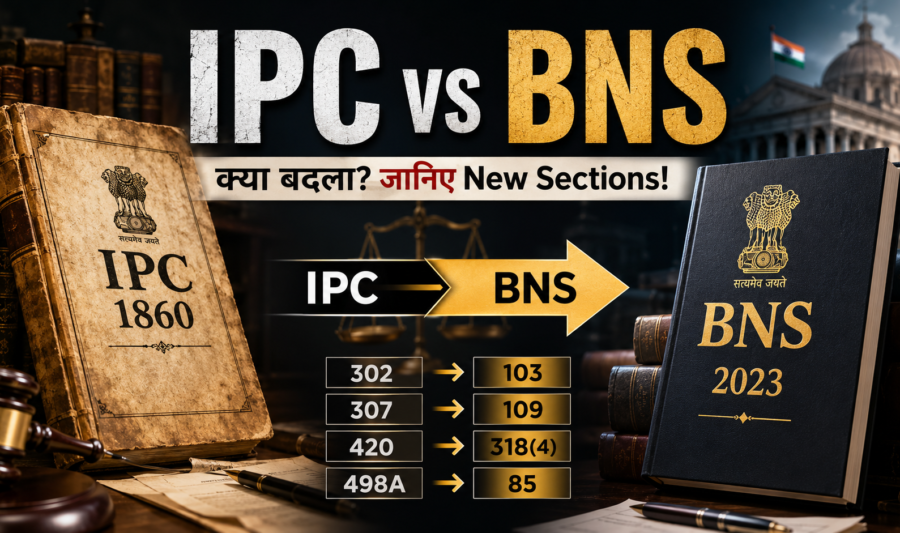
India’s criminal law system witnessed a major change with the introduction of the Bharatiya Nyaya Sanhita, 2023 (BNS). The BNS replaced the Indian Penal Code, 1860 (IPC) as the principal law defining offences and punishments, with the new criminal-law framework coming into force from 1 July 2024. Ministry of Home Affairs
For anyone dealing with an FIR, criminal case, police complaint, bail matter, cheating case, property dispute, cyber crime or other criminal proceedings, understanding the difference between IPC and BNS is now extremely important.
What Is the Difference Between IPC and BNS?
The Indian Penal Code (IPC), 1860 was the primary criminal law of India for more than 160 years. The Bharatiya Nyaya Sanhita (BNS), 2023 introduced a new structure and renumbered many offences while also introducing or modifying certain provisions.
BNS contains 358 sections, arranged across 20 chapters, including provisions dealing with offences against women and children, offences against the human body, property offences, criminal intimidation, defamation and other crimes. Hhttps://www.taxmann.com
The important point is:
IPC Section numbers should not automatically be treated as the corresponding BNS Section numbers.
For example:
IPC 302 → BNS 103
IPC 307 → BNS 109
IPC 420 → BNS 318(4)
20 Important IPC vs BNS Sections
| No. | Offence | Old IPC Section | New BNS Section |
|---|---|---|---|
| 1 | Murder | IPC 302 | BNS 103 |
| 2 | Attempt to Murder | IPC 307 | BNS 109 |
| 3 | Culpable Homicide | IPC 304 | BNS 105 |
| 4 | Death by Negligence | IPC 304A | BNS 106(1) |
| 5 | Abetment of Suicide | IPC 306 | BNS 108 |
| 6 | Rape – Punishment | IPC 376 | BNS 64 |
| 7 | Dowry Death | IPC 304B | BNS 80 |
| 8 | Cruelty by Husband/Relatives | IPC 498A | BNS 85 |
| 9 | Assault/Criminal Force to Woman | IPC 354 | BNS 74 |
| 10 | Sexual Harassment | IPC 354A | BNS 75 |
| 11 | Stalking | IPC 354D | BNS 78 |
| 12 | Theft | IPC 379 | BNS 303 |
| 13 | Criminal Breach of Trust | IPC 406 | BNS 316 |
| 14 | Cheating | IPC 420 | BNS 318(4) |
| 15 | Criminal Intimidation | IPC 506 | BNS 351 |
| 16 | Defamation | IPC 499/500 | BNS 356 |
| 17 | Criminal Conspiracy | IPC 120A/120B | BNS 61 |
| 18 | Common Intention | IPC 34 | BNS 3(5) |
| 19 | Unlawful Assembly | IPC 141 | BNS 187/189 framework |
| 20 | Acts Endangering Sovereignty, Unity & Integrity | IPC 124A | BNS 152 |
The official BNS text confirms, among other provisions, BNS 103 for murder and BNS 109 for attempt to murder. The Uttar Pradesh Police comparative table is also a useful reference for IPC-to-BNS correspondence. Ministry of Home Affairs+1
Note: Some mappings are not a simple one-to-one replacement. For example, theft-related provisions are structured differently under BNS, and provisions such as IPC 34 and IPC 141 need to be understood in the context of the relevant BNS provisions rather than treated as simple numerical substitutions.
1. IPC 302 vs BNS 103 – Murder
One of the most searched criminal-law comparisons is:
IPC Section 302 → BNS Section 103
Under the new criminal law, punishment for murder is provided under BNS Section 103. Ministry of Home Affairs
This is particularly relevant in serious murder cases, FIRs, criminal trials and bail proceedings.
2. IPC 307 vs BNS 109 – Attempt to Murder
The offence commonly known under IPC Section 307 (Attempt to Murder) is addressed under BNS Section 109.
The punishment and ingredients of the offence should always be examined according to the exact facts of the case rather than relying only on the section number. Ministry of Home Affairs
3. IPC 420 vs BNS 318 – Cheating
IPC 420 was one of the most commonly used sections for cheating and dishonest inducement involving delivery of property.
Under BNS, the relevant provision is found in Section 318, with Section 318(4) covering the aggravated form involving cheating and dishonest inducement to deliver property.
This is important for fraud cases, financial cheating, online fraud and business disputes.
4. IPC 498A vs BNS 85 – Cruelty
The familiar IPC 498A provision concerning cruelty by a husband or relative of the husband has been carried into the BNS framework through Section 85, read with the associated provision defining cruelty.
This can be relevant in matrimonial disputes, domestic violence-related criminal complaints and dowry-related cases.
5. IPC 376 vs BNS 64 – Rape
The principal punishment provision corresponding to IPC 376 is BNS Section 64.
Sexual offences under BNS are placed in the chapter dealing with offences against women and children, beginning with the relevant provisions on sexual offences.
Major Changes from IPC to BNS
1. New Section Numbers
One of the biggest practical changes is the renumbering of criminal offences.
Therefore, someone familiar with IPC Sections may need an IPC to BNS conversion chart to understand the corresponding provision under the new law.
For example:
IPC 302 → BNS 103
IPC 307 → BNS 109
IPC 420 → BNS 318(4)
IPC 498A → BNS 85
IPC 376 → BNS 64
2. New and Modified Criminal Offences
BNS also introduced provisions addressing areas such as organised crime and terrorist acts, alongside changes to the structure of several existing offences.
This means the transition from IPC to BNS is more than simply changing section numbers.
3. Sedition and BNS Section 152
A frequently discussed change concerns IPC Section 124A (Sedition).
BNS Section 152 deals with acts endangering the sovereignty, unity and integrity of India. Its wording and scope should not be assumed to be an exact word-for-word replacement of IPC 124A.
4. Property and Theft Offences
BNS reorganises property offences into a different structure. Theft is addressed under BNS Section 303, followed by separate provisions dealing with other forms of theft and related property offences. PRS India
Therefore, when dealing with a theft FIR or property-related criminal case, the exact facts and applicable BNS provision should be checked.
Does BNS Apply to Every Criminal Case?
No.
The date of the alleged offence and the applicable transitional/savings provisions are important. A case involving an incident that occurred before the new laws came into force cannot be classified simply by looking at the date on which the FIR was registered.
For an actual FIR, arrest, bail application, charge sheet or criminal complaint, the incident date and facts should be examined carefully before determining which substantive criminal law applies.
Why Should You Know IPC vs BNS?
Understanding IPC vs BNS can help you read and understand:
- FIR and police complaints
- Criminal case documents
- Bail applications
- Charge sheets
- Court orders
- Cheating and fraud complaints
- Criminal intimidation cases
- Property-related criminal cases
- Cyber crime complaints
- Matrimonial and cruelty cases
- Serious offences such as murder and attempt to murder
If you are searching for BNS sections in India, IPC to BNS section list, IPC vs BNS comparison, new criminal law in India, BNS 2023, criminal lawyer in Lucknow, advocate in Lucknow or legal consultation in Lucknow, knowing the basic section mapping is a useful starting point.
Conclusion: IPC vs BNS – What Has Changed?
The transition from Indian Penal Code (IPC) to Bharatiya Nyaya Sanhita (BNS) represents a significant change in India’s criminal-law framework.
The most important thing to remember is that BNS is not merely an IPC section-number conversion exercise. Many provisions have been reorganised, some offences have new formulations, and certain new offences have been introduced.
If you are involved in a criminal case, FIR, bail matter, cheating case, cyber crime, property dispute, matrimonial dispute or any other legal matter, do not rely solely on an online IPC vs BNS chart. The applicable law depends on the facts, date of occurrence and specific legal provisions.
Legal Keywords / SEO Keywords
IPC vs BNS, IPC to BNS Section List, IPC vs BNS Sections, BNS 2023, Bharatiya Nyaya Sanhita 2023, New Criminal Law in India, Old Law vs New Law in India, IPC 302 vs BNS 103, IPC 307 vs BNS 109, IPC 420 vs BNS 318, IPC 498A vs BNS 85, IPC 376 vs BNS 64, BNS Sections List, BNS Sections in English, Criminal Law India, Criminal Lawyer in Lucknow, Criminal Advocate in Lucknow, Lawyer in Lucknow, Legal Advice in Lucknow, Legal Consultant in Lucknow, FIR Lawyer, Bail Lawyer, Cyber Crime Lawyer, Property Dispute Lawyer, Family Lawyer, Criminal Case Lawyer.
Disclaimer: This article is for general legal awareness and educational purposes only. It should not be treated as case-specific legal advice. For an actual matter, consult a qualified advocate after reviewing the complete facts and documents.