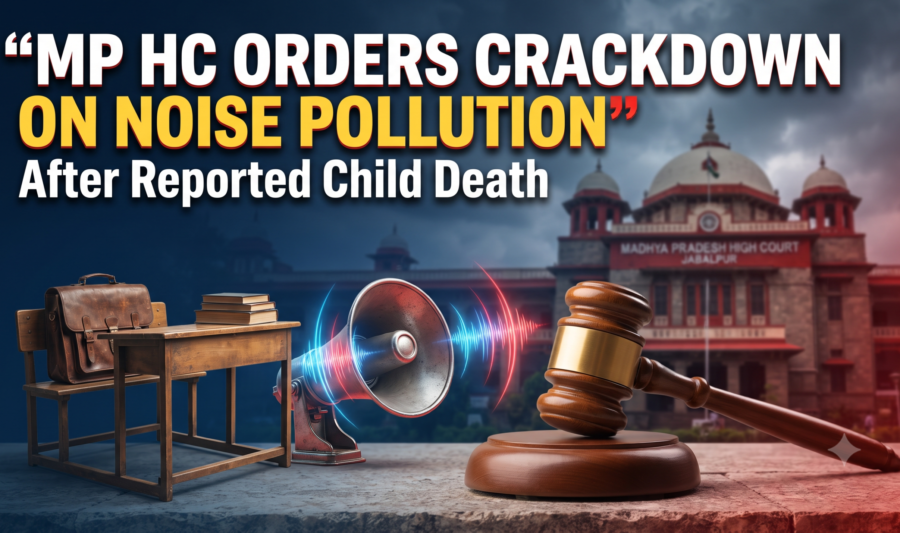
Madhya Pradesh High Court on Noise Pollution: The Madhya Pradesh High Court has directed the State government and authorities to strictly enforce noise pollution laws after taking note of reports that a seven-year-old schoolchild died allegedly due to excessive loudspeaker noise from a passing procession.
A Division Bench comprising Justice Subodh Abhyankar and Justice Jai Kumar Pillai passed the directions on September 24 while hearing a public interest litigation concerning noise pollution in Indore.
Madhya Pradesh HC Takes Note of Ground Reality
The Bench observed that it had itself witnessed loudspeakers operating at excessive volumes while travelling from the High Court to the judges’ residences.
The Court noted that despite a detailed response from government authorities claiming that measures were being taken to control noise pollution, the situation on the ground appeared different.
The PIL, filed in 2023, raised concerns over excessive noise from loudspeakers, DJs, religious programmes, processions, marriages and other public events.
The petitioners argued that uncontrolled noise pollution affects the right to life under Article 21 of the Constitution, including the right to peaceful sleep.
Court Orders Strict Enforcement of Noise Rules
The High Court directed police and administrative authorities to ensure compliance with the Noise Pollution (Regulation and Control) Rules, 2000 and the Madhya Pradesh Kolahal Niyantran Adhiniyam, 1985.
The Court also directed authorities to:
- Take strict legal action against violations of noise pollution norms.
- Publicise designated silence zones through widely circulated newspapers.
- Invite public representations for declaring additional prominent areas as silence zones.
- Publicise helpline and contact numbers for filing noise pollution complaints.
- Submit a fresh compliance report to the Court within one week.
The matter has been listed for further consideration on October 5, 2026.
Noise Pollution and Legal Remedies
The Madhya Pradesh High Court’s directions highlight the legal obligations of authorities to regulate excessive noise and protect residents from violations of prescribed noise standards.
For information on legal rights, constitutional remedies, public interest litigation and other legal matters, readers can explore the resources available through {“fallbackMarkdown”:”VS Advocates Legal“,”reference”:{“matched_text”:””,”prefix”:null,”start_idx”:2795,”end_idx”:2849,”safe_urls”:[],”refs”:[],”alt”:”VS Advocates Legal“,”prompt_text”:”VS Advocates Legal“,”type”:”url”,”title”:”VS Advocates Legal”,”item”:{“title”:”VS Advocates Legal”,”url”:”https://vsadvocateslegal.com/?utm_source=chatgpt.com”,”attribution”:”vsadvocateslegal.com”,”pub_date”:null,”snippet”:null,”attribution_segments”:null,”supporting_websites”:null,”refs”:[],”hue”:null,”attributions”:null},”layout”:null,”logo”:null},”showLoginRequiredCard”:false}.
Related Legal Topics
- Noise pollution laws in India
- Article 21 and the right to peaceful life
- Public Interest Litigation (PIL) in India
- Legal remedies against noise pollution
- Silence zones and loudspeaker regulations
- Environmental law and citizens’ rights
Source: Madhya Pradesh High Court order dated September 24, 2026, in Amitabh Upadhyay and Others v. State of Madhya Pradesh and Others.