Published: 17 September 2026
Reading Time: 6–8 minutes
Category: Legal News | Delhi High Court | Right to Privacy | Legal Research
SEO Title: Most Lawyers Can’t Afford Paid Legal Databases: Delhi HC on Indian Kanoon Right to Be Forgotten Case
Meta Description: Delhi High Court examines whether masking judgments under the right to be forgotten could affect lawyers’ access to free legal research platforms such as Indian Kanoon.
Focus Keyword: Delhi High Court right to be forgotten case
Secondary Keywords: Indian Kanoon right to be forgotten, right to be forgotten India, Delhi High Court latest news, access to court judgments, legal research India, privacy rights Article 21, judicial records masking, Indian legal databases
Delhi High Court Examines Free Access to Judgments in Indian Kanoon Case
The ongoing debate over the right to be forgotten and public access to judicial records has taken another significant turn before the Delhi High Court.
On September 17, 2026, a Division Bench comprising Justice C Hari Shankar and Justice Vinod Kumar heard appeals concerning the masking and name-based accessibility of judgments available on online legal research platforms.
At the heart of the proceedings is a practical question with potentially wide implications for the legal profession:
If a judgment is difficult to find by the names of the parties, how will lawyers who rely on free legal databases locate that judgment?
The issue has assumed particular importance because platforms such as Indian Kanoon provide free access to a large collection of Indian judgments and court orders.
During the hearing, the Court considered concerns about the impact that restrictions on the online discoverability of judgments could have on lawyers who may not have access to expensive commercial legal research databases.
What Is the Right to Be Forgotten?
The right to be forgotten broadly refers to an individual’s ability, in appropriate circumstances, to seek removal, de-indexing or restriction of personal information from publicly accessible digital platforms.
In India, the issue has developed primarily through the constitutional understanding of privacy and informational autonomy under Article 21.
The Delhi High Court considered the issue in a judgment delivered on May 29, 2026, in Laksh Vir Singh Yadav v. Union of India & Ors.
The judgment examined the right to be forgotten in the context of informational privacy and discussed circumstances in which restrictions such as masking or de-indexing of information connected with judicial records could be sought.
The controversy, however, extends beyond the question of whether personal information should remain online.
The larger issue is:
Can the original judicial record remain intact while its online discoverability is restricted?
Why Indian Kanoon Has Become Central to the Debate
Indian Kanoon is widely used as a free resource for searching Indian judgments, statutes and court orders.
Unlike subscription-based legal research services, free platforms can be particularly useful for advocates, students, litigants and researchers who do not have access to paid databases.
This accessibility became an important aspect of the arguments concerning the masking of judgments.
The concern raised before the Delhi High Court is essentially practical: if judgments become difficult to locate through ordinary name-based searches, legal research could become more complicated for lawyers who depend on freely accessible databases.
A lawyer may know the name of a party involved in earlier litigation but may not know:
- The case number
- The exact citation
- The date of judgment
- The bench that heard the matter
- The relevant legal provision
Name-based search can therefore be an important starting point for legal research.
Most Lawyers Cannot Simply Rely on Paid Databases
One of the significant aspects discussed during the September 17 proceedings was the affordability of commercial legal research services.
Large law firms and well-funded legal practices may have access to multiple subscription-based databases. But that does not necessarily reflect the situation of every advocate.
For lawyers practising in district courts, trial courts and smaller towns, free online resources can be an important source of judgments and legal materials.
The Court’s discussion therefore brought the issue of privacy into contact with another aspect of access to justice: access to legal information.
The question is not simply whether a judgment should be available.
It is also about how easily and affordably lawyers can find it.
Why Name-Based Search Matters in Legal Research
Legal research is often conducted using multiple identifiers.
A lawyer may search for a judgment using:
- Party names
- Case title
- Legal provisions
- Subject matter
- Court
- Citation
- Case number
- Judgment date
- Keywords
Case numbers and citations can be highly effective when they are already known.
But legal research frequently begins without that information.
For example, an advocate may remember only the name of a party or the broad issue involved in an earlier case.
If the names appearing in a judgment are masked or removed from searchable versions, locating the decision could require additional information.
That is the practical concern behind the argument over name-based accessibility of judgments.
Privacy vs Access to Judicial Records
The proceedings bring together two important interests.
1. Protection of informational privacy
Individuals involved in litigation may have legitimate concerns about the continuing digital availability of their personal information.
Judicial proceedings can contain sensitive details relating to:
- Family disputes
- Medical information
- Personal relationships
- Sexual offences
- Identity-related information
- Allegations that were later rejected
- Acquittals, discharges or quashing of proceedings
The fact that information once appeared in a court proceeding does not necessarily mean that an individual has no privacy interest in its continuing digital dissemination.
The May 2026 Delhi High Court judgment considered these concerns within the broader framework of informational privacy under Article 21.
2. Public access to law
Judgments are also an essential component of the Indian legal system.
Courts interpret statutes, develop constitutional principles and establish precedents that lawyers and litigants rely upon in later cases.
Access to those decisions is therefore important for:
- Advocates
- Judges
- Litigants
- Researchers
- Law students
- Journalists
- Members of the public
The present dispute asks how these interests can coexist in an increasingly digital legal system.
Does Masking a Judgment Mean the Record Is Destroyed?
Not necessarily.
An important distinction in the debate is between the underlying judicial record and the publicly searchable digital version of that record.
The court record may continue to exist in its complete form even if certain identifying information is masked or a publicly accessible version is subject to restrictions.
This distinction matters because:
Preservation of a court record and unrestricted internet discoverability are two different questions.
A judgment may remain part of the official judicial record while its online accessibility through particular search terms is restricted.
What Happens When One Database Masks a Judgment but Another Does Not?
Another practical issue raised in the litigation concerns consistency across legal databases.
If a judgment is masked on one platform but remains available in an unredacted form on another platform, the effectiveness of the privacy restriction can become complicated.
For example, a person might be unable to locate a judgment through one free database while the same judgment remains searchable through a paid service.
This creates two separate questions:
Does partial masking actually protect privacy?
And:
Could wider restrictions unintentionally make legal research more dependent on paid services?
The answers may depend on the scope of any eventual judicial directions and how different legal databases implement them.
Delhi HC Questions a Blanket Approach
The Division Bench has also considered whether privacy concerns in individual cases necessarily require a broad restriction on the discoverability of judicial records.
One approach would be to examine the circumstances of individual cases and allow affected persons to seek appropriate relief from the concerned court.
This raises a broader legal question:
Should restrictions on online judicial records operate automatically, or should privacy concerns be examined on a case-by-case basis?
The observations made during the hearing remain part of the ongoing proceedings and should not be treated as a final decision on the appeals.
Why This Case Matters to Lawyers
The dispute has implications beyond Indian Kanoon.
Affordable access to judgments can directly affect everyday legal work.
Lawyers use case-law databases for:
- Preparing arguments
- Finding precedents
- Drafting pleadings
- Researching statutory provisions
- Checking previous orders
- Comparing judicial approaches
- Advising clients
- Preparing constitutional arguments
For advocates without access to multiple commercial databases, free legal research platforms can reduce the cost of obtaining basic case-law information.
That makes the Delhi High Court proceedings relevant not only to privacy law but also to the broader question of digital access to justice.
Privacy Protection Is Also Important
The access-to-justice concern does not eliminate the privacy issue.
Digital publication can fundamentally change the way information contained in a court record is accessed.
A physical record may require someone to visit a court, identify the relevant file and conduct research.
An online database can make the same information searchable within seconds.
That difference can make judicial records far more accessible—and can also make personal information far more persistent.
The challenge for courts is therefore not simply choosing between privacy and transparency.
It involves determining:
- What information should remain publicly searchable?
- When should identifying information be masked?
- Who should be able to seek such masking?
- Should restrictions apply to all databases?
- How should lawyers continue to locate relevant precedents?
- How can privacy protection coexist with open justice?
What Happens Next?
The Delhi High Court is continuing to hear the appeals concerning the right-to-be-forgotten framework and accessibility of judicial records.
According to reports concerning the September 17 proceedings, the matter is scheduled for further hearing on September 21, 2026.
Until the appeals are finally decided, observations made during hearings should be understood as part of the Court’s ongoing consideration of the issues rather than as a final ruling on every question involved.
Key Takeaways
- Right to be forgotten: Concerns the restriction, removal or de-indexing of personal information in appropriate circumstances.
- Article 21: The Delhi High Court’s 2026 judgment considered the issue within the broader framework of informational privacy.
- Indian Kanoon: The free legal research platform is involved in the dispute over the accessibility and searchability of certain judicial records.
- Lawyer access: The proceedings have highlighted concerns that restrictions on searchable judgments could create practical difficulties for advocates who rely on free legal databases.
- Open justice: Judicial decisions are important sources of law and are used by lawyers, litigants, researchers and students.
- Privacy: Individuals may have legitimate concerns about the continuing online association of their names with judicial proceedings.
- No final resolution yet: The appeals remain pending, with the matter scheduled for further hearing on September 21, 2026.
Frequently Asked Questions
What is the right to be forgotten in India?
The right to be forgotten generally refers to seeking removal, de-indexing or restriction of personal information from publicly accessible digital platforms in appropriate circumstances. Indian courts have considered the issue in connection with informational privacy under Article 21.
Why is Indian Kanoon involved in the Delhi High Court case?
Indian Kanoon has challenged directions affecting the accessibility and searchability of certain judicial records. The proceedings have raised concerns about how such restrictions could affect legal research and public access to judgments.
Does masking a judgment mean that the court record is destroyed?
No. Masking or restricting an online version of a judgment does not necessarily mean that the underlying judicial record is destroyed. The distinction between the official court record and its publicly searchable digital version is important to the dispute.
Why is free access to judgments important?
Free legal databases can provide judgments and legal materials to advocates, litigants, students and researchers who may not subscribe to commercial legal research services. The affordability of legal research was an important practical issue discussed during the September 17 proceedings.
When is the next hearing?
The matter is scheduled for further hearing on September 21, 2026, according to reports of the September 17 proceedings.
Suggested Internal and External Links
For a legal website such as VS Advocates, contextual links can be placed naturally within the article rather than adding a separate block of unrelated links.
Internal Link Ideas
- Right to Privacy in India
- Article 21 and Constitutional Rights
- Delhi High Court Legal News
- Legal Research & Case Law
- Advocate Services in High Court
- Civil Litigation Services
- Legal Consultation
- Latest Indian Legal Updates
External Reference Ideas
- Delhi High Court — Official Website
- Indian Kanoon — Delhi High Court Judgments
- LiveLaw — Delhi High Court Proceedings
- Bar & Bench — September 17 Proceedings
- SCC Times / SCC Online — Analysis of the right-to-be-forgotten framework
SEO-Friendly URL Slug
/delhi-high-court-right-to-be-forgotten-indian-kanoon-legal-access/
Suggested Image Alt Text
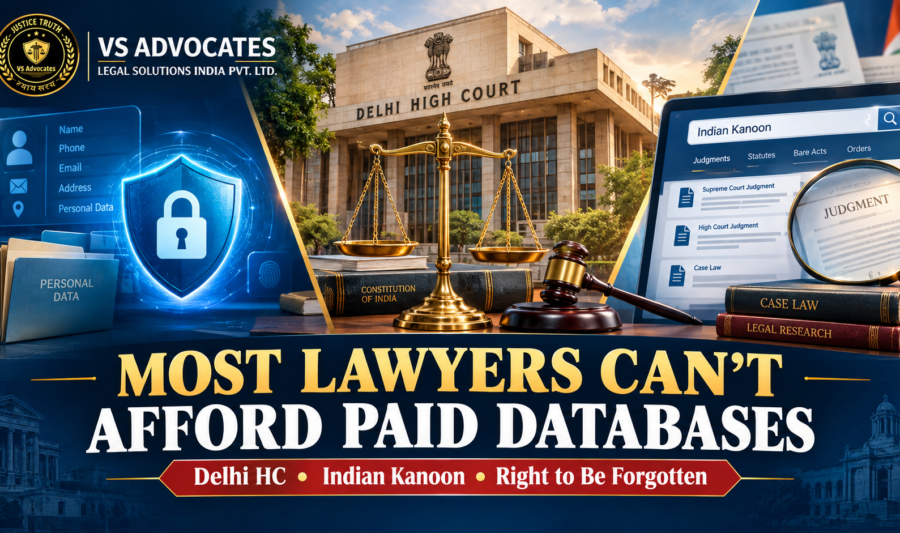
“Delhi High Court right to be forgotten case involving Indian Kanoon and free access to judicial judgments for lawyers”
Social Media Caption
Social Media Caption
Most lawyers can’t afford paid legal databases.
The Delhi High Court has examined an important question in the ongoing Indian Kanoon right-to-be-forgotten case: how should individual privacy be balanced with lawyers’ need for affordable access to judicial judgments?
The proceedings raise wider issues around Article 21, informational privacy, open justice, name-based case searches and access to legal research.
The matter is scheduled for further hearing on September 21, 2026.
Read the complete legal update to understand what is at stake for privacy, judicial records and legal research in India.
#DelhiHighCourt #RightToBeForgotten #IndianKanoon #LegalNews #IndianLaw #Article21 #RightToPrivacy #LegalResearch #JudicialRecords #Lawyers #LegalUpdates #VSAdvocates