
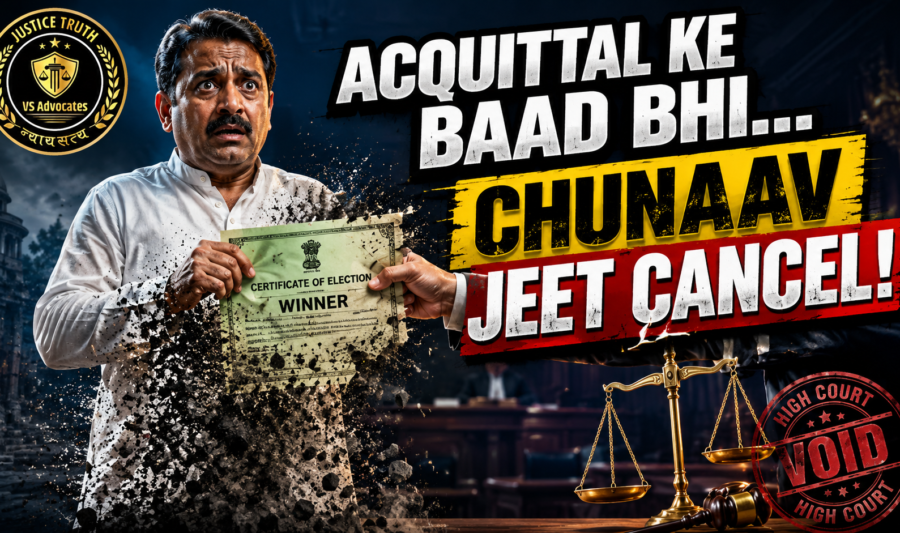
In a major verdict clarifying electoral integrity and statutory transparency, the Madhya Pradesh High Court has held that a candidate’s later acquittal in a criminal matter does not remedy the deliberate non-disclosure of that pending case at the time of filing nomination papers.
Affirming the annulment of a Panchayat election, a Division Bench comprising Acting Chief Justice Vivek Rusia and Justice Pradeep Mittal held that electoral disclosures must be strictly accurate on the date of submission. Writing for the Bench, Justice Mittal observed that subsequent exoneration cannot retrospectively validate a nomination that was inherently liable to be rejected at the threshold.
Case Background: Margin of Victory vs. Suppression of Facts
The appellant, Raj Mani Patel Mishri Lal, contested a local panchayat election and won by a decisive margin of 502 votes, securing 2,174 votes against respondent Suresh Tripathi’s 1,672 votes. While the Returning Officer initially accepted the appellant’s nomination papers without objection during the scrutiny stage, Tripathi later challenged the victory before the Election Tribunal under Section 122 of the Madhya Pradesh Panchayat Raj Avam Gram Swaraj Adhiniyam, 1993.
The election petition alleged that Patel had suppressed critical information in his declaration affidavit, including:
- Pending Criminal Proceedings: Specifically, Crime No. 373/2011 and Criminal Case No. 10611/12 before the Judicial Magistrate First Class (JMFC), Hanumana.
- Undisclosed Government Dues: A recovery demand order of ₹13,55,146 issued by the Executive Engineer.
- Statutory Penalties: An unpaid penalty of ₹2,40,000 imposed under the Mines and Minerals (Development and Regulation) Act, 1956.
When the District Collector (acting as the Election Tribunal) set aside the election, Patel appealed before a Single Judge of the High Court. Following the dismissal of his writ petition on March 18, 2026, Patel approached the Division Bench.
The Legal Defense: “Acquitted After Election & Substantial Margin”
Before the Division Bench, the appellant argued that:
- He had already secured an acquittal in the criminal proceedings on October 13, 2022, shortly after the election concluded.
- The nomination form’s Columns 11 and 12 were marked “Nil” because the offences did not carry severe convictions.
- His election win was backed by a 502-vote mandate, and precedent suggests minor irregularities should not overturn voter will.
- The Tribunal violated natural justice by relying on an ex-parte inquiry report compiled by the Sub-Divisional Officer (SDO), Hanumana.
The High Court’s Findings: The Point of Reckoning
The High Court categorically dismissed these arguments, reaffirming the strict mandates governing democratic disclosure:
- Relevant Date is the Date of Filing: The Bench ruled that under Rule 31-A of the Madhya Pradesh Panchayat Nirvachan Niyam, 1995, disclosure of criminal antecedents is mandatory. The benchmark date is the date of filing the nomination (June 4, 2022). Because criminal cases were pending against him on that precise date, writing “Nil” constituted an active suppression of material facts.
- Acquittal Does Not Operate Retrospectively: An acquittal achieved months after filing nomination papers cannot cure the defect. The court noted:“The subsequent acquittal does not cure the omission, as the relevant date for disclosure was the date of filing of the nomination.”
- Vote Margins Do Not Excuse Corrupt Practice: The Bench firmly clarified that the protection of a large victory margin applies when a rival’s nomination was improperly accepted, not when the winning candidate gained entry through an invalid, fraudulent affidavit.
- No Procedural Defect: The court found that the Election Tribunal exercised independent judicial assessment and gave Patel an adequate hearing, rejecting the plea of procedural bias.
Finding no jurisdictional error or perversity in the orders of the Election Tribunal and the Single Judge, the Division Bench dismissed the writ appeal.
Case Summary Table
| Particulars | Details |
| Case Title | Raj Mani Patel Mishri Lal vs. The State of Madhya Pradesh and Others (WA-2757-2026) |
| Citation | 2026 LiveLaw (MP) 347 |
| Court | High Court of Madhya Pradesh (Jabalpur Bench) |
| Coram | Acting Chief Justice Vivek Rusia and Justice Pradeep Mittal |
| Author of Order | Justice Pradeep Mittal |
| Order Date | August 25, 2026 |
| Key Statutes & Rules | Rule 31-A, MP Panchayat Nirvachan Niyam, 1995; Section 122, MP Panchayat Raj Avam Gram Swaraj Adhiniyam, 1993 |
Key Legal Takeaway
This judgment emphasizes that complete, truthful disclosure in nomination affidavits is a prerequisite to holding public office, even at local governance levels. An omission or false statement regarding pending criminal prosecutions, outstanding government dues, or regulatory penalties strikes at the root of a candidate’s eligibility. Electors possess an indefeasible right to know the background of who they are voting for, and clean-slate rulings obtained post-election cannot wipe out intentional omissions made at the ballot stage.