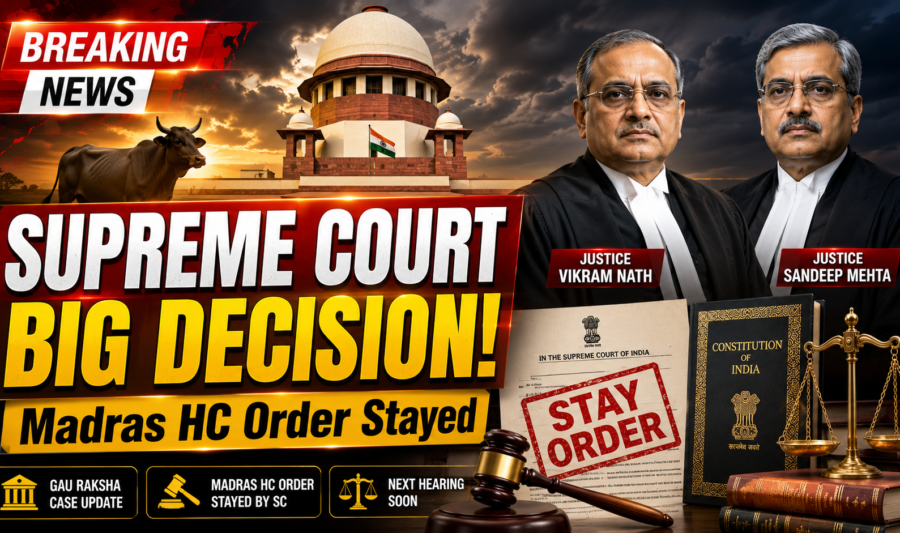
In a significant legal development, the Supreme Court of India has stayed the Madras High Court’s order that imposed a blanket ban on the slaughter of cows and calves across Tamil Nadu during Bakrid and on all other days. The interim relief was granted on July 13, 2026, by a Bench comprising Justice Vikram Nath and Justice Sandeep Mehta while hearing a Special Leave Petition (SLP) filed by the State of Tamil Nadu.
The Supreme Court observed that the final portion of the Madras High Court’s order prima facie required correction and issued notice in the matter.
Why Did the Supreme Court Stay the High Court Order?
The Tamil Nadu Government challenged the Madras High Court’s direction, arguing that it exceeded the scope of existing laws governing animal slaughter in the state.
According to the State, the Tamil Nadu Animal Preservation Act, 1958 permits the slaughter of cows that:
- Are over 10 years of age.
- Are permanently unfit for work or breeding.
- Have received certification from the competent authority.
The government further argued that several other laws, including the Prevention of Cruelty to Animals Act, 1960, the Prevention of Cruelty to Animals (Slaughter House) Rules, 2001, and the Tamil Nadu Urban Local Bodies Rules, 2023, regulate animal slaughter but do not impose a complete prohibition.
Background of the Case
The Madras High Court had passed its order on May 27, 2026, while hearing a Public Interest Litigation (PIL) filed before Bakrid.
The original petition requested that authorities ensure animal slaughter takes place only at designated slaughterhouses and not in public places. However, the High Court expanded the scope of the case and directed that no cow or calf should be slaughtered anywhere in Tamil Nadu, not only during Bakrid but on any day.
The State Government argued before the Supreme Court that such a blanket prohibition was never sought by the petitioner.
State Government’s Arguments
During the hearing, Senior Advocate Dr. Abhishek Manu Singhvi represented the State of Tamil Nadu.
The State submitted that:
- The High Court’s order contradicts the statutory provisions of the Tamil Nadu Animal Preservation Act, 1958.
- Courts cannot replace legislative policy by issuing directions inconsistent with existing law.
- The blanket ban amounts to judicial legislation rather than judicial interpretation.
- Executive government orders cannot override statutory enactments passed by the legislature.
- The relief granted by the High Court went beyond the prayers made in the PIL.
The government also pointed out that the police had already assured the High Court that preventive measures were in place to ensure no slaughter would occur in public places.
Supreme Court’s Interim Observations
While issuing notice, the Supreme Court observed that the concluding portion of the Madras High Court’s judgment appeared to require correction.
Although the Court has not finally decided the matter, the stay order ensures that the statutory provisions governing animal slaughter in Tamil Nadu continue to operate until further hearings.
Legal Significance of the Judgment
This case raises several important constitutional and legal questions:
- Whether courts can issue directions contrary to statutory provisions.
- The limits of judicial intervention in matters governed by legislation.
- Interpretation of the Tamil Nadu Animal Preservation Act, 1958.
- Balance between public interest litigation and legislative intent.
- Scope of judicial review in matters involving religious festivals and public administration.
The final judgment is expected to clarify the relationship between judicial directions and statutory law in India.
What Happens Next?
The Supreme Court has issued notice on the State’s Special Leave Petition and stayed the operation of the Madras High Court’s blanket ban.
The matter will now proceed for detailed consideration, where the Court will examine:
- The legality of the High Court’s directions.
- Whether the blanket prohibition was constitutionally sustainable.
- Whether the High Court exceeded the relief sought in the PIL.
The final decision is likely to have a significant impact on future cases involving judicial review, statutory interpretation, and animal preservation laws in India.
Conclusion
The Supreme Court’s interim stay marks an important development in Indian constitutional and administrative law. By pausing the blanket ban imposed by the Madras High Court, the apex court has signaled that statutory provisions enacted by the legislature must remain central to judicial decision-making unless found unconstitutional.
The outcome of this case will be closely watched by legal experts, policymakers, and citizens alike, as it may shape the future interpretation of animal preservation laws and the limits of judicial intervention.